

WHY RAISE?
And WHY NOT TO RAISE


THESIS: The decision to raise—or not raise—capital is fundamentally an investment decision, not a rite of passage. Once a company reaches early scale, founders must act less like fundraisers and more like investors—objectively weighing dilution against growth acceleration, independence against optionality, and strategic partnerships against new risks.
Congrats. You made it through the Zero- to-One phase. You have early scale, a business that is real and generating a decent amount of traction in a repeatable way. You raised some venture capital in the early days, before you knew if this experiment was going to work. And it turns out the experiment was a success. Or rather, the dozens and dozens of experiments you ran turned into a real going concern.
So what happens next?
The question, especially when a company has reached ~$5M of ARR or $10M of topline revenue, or some other representation of clear business achievement, is not as straightforward as it might appear. Just because you have raised venture capital once doesn’t mean that you need to KEEP raising venture capital in perpetuity. But it also doesn’t necessarily mean you can spike the football, either. You have a key decision to make: to raise or not to raise.
The reality is that as a manager of a company, you are an investor. It’s a paradox, but it’s true. CEOs and executives at companies have to constantly be allocating capital, be it literal cash spend or human capital or even focus capital (time does equal money, after all). But no matter what, the allocations you are constantly making can and will impact the trajectory of your business. And once you get to an early level of scale these capital decisions become more and more important.
A trap a lot of managers make is they just do what they have done in the past. But as everyone in the investing world knows: past results are not necessarily indicative of future returns. What got you here won’t get you there. Every capital decision needs to be analyzed in as much of a vacuum as possible.
So if you have raised venture capital to get to where you are, that doesn’t mean you NEED to raise venture capital moving forward. And the reverse is true as well – if you bootstrapped to get to a certain level, that doesn’t mean that bootstrapping is the only way to go.
As a result, I broke down two simple formulas to determine WHY TO RAISE and WHY NOT TO RAISE.
WHY RAISE?
Theoretically speaking, the number one reason for any capital raising activity for a for-profit organization, is to accelerate growth and / or profitability. If a tech company is soliciting capital from a bunch of investors, it is certain that those investors are definitely asking themselves whether or not there is a better way to generate returns using the capital they are putting to work. They are constantly assessing every investment opportunity against the opportunity costs of not doing other investments.
The operator should ask that question as well. If they raise capital, the trade off is that they are selling a piece of their business, so the real investment that the Company is making is via dilution - could they put their equity capital to better work?
Let’s look at an example:
Let’s say that a company has put together a financial model with a fundraise that assumes that they add ~$5M of incremental ARR on top of $7.5M of ARR year end 2025, and hit a ~60-70% annual growth rate, reaching ~$12.5M topline in 2026. Assuming a 6x revenue multiple (median rate for a SaaS business like this in the current market), that means we are generating an incremental $30M in EV in Year 1, BUT, we are giving up ~26% of the business ($12M raised on a ~$45M EV today). If we grow at that proposed rate, compared to the steady state 35% topline without the fundraise, the EV trade off is close to breakeven (see spreadsheet below), even if we wait 3 years to exit at a larger amount.
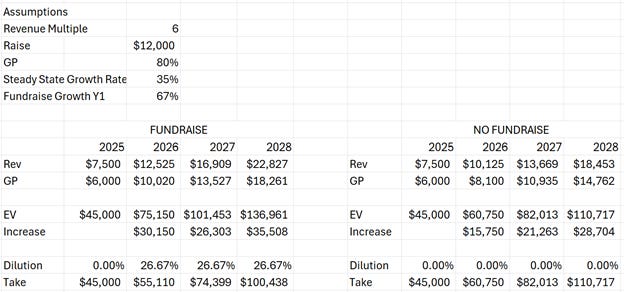
In this scenario, the EV is higher in the fundraise scenario, but the actual take for the existing investors, because of dilution, is less. That raise was dilutive in the truest sense of the word. If this were flipped, and the EV grew and the take grew, that’s called making the pie bigger. That’s a solid green light for fundraising.
The punchline is that the Company likely needs to grow to 80-90% in year one to make the raise worth the dilution. Alternatively they could raise closer to $9M of venture capital at that same valuation or OR take on less than ~20% dilution, that probably makes the math work, with the previously described growth assumptions. Put more simply, even if a company raises capital, their take home when everything is said and done could be less, even if the capital helps grow the overall enterprise value of the business.
All of this is to say that fundraising simply because that’s the only way you know how to grow is not the right way to think about it. There is math that you can do to determine if the net outcome is better or worse for existing owners in the company. Again, you have to assume that new investors are doing this math as well, but that makes it more important you do it yourself in order to understand what their real growth assumptions are.
There is also a scenario where fundraising makes sense in order to launch a new product or service. But this falls under this category as well because the intention behind that would be to accelerate revenue or improve profitability, either directly or indirectly. The same formula can be applied.
The other big reason (and in some environments the most critical reason) to raise is to build a cash cushion. The scenario described above is doing a TON of assumption work, and, as we all know, there are no guarantees in life, and definitely no guarantees in startups. Having a cash cushion can help a company build a fortress in the event of a market downturn, a company hiccup, a customer issue, or otherwise.
Some people will tell you there is a right amount to reserve in the event of a downturn, but I don’t think there is a magic number. There is a cash reserve number good managers should inherently understand that they need in the event that something goes sour. If you are a manager who doesn’t pay any attention to your finance function (for shame), the one thing you should still pay attention to is how much cash do you need to get to breakeven. That is a fluid number, but that’s sort of the primary function of an accounting and finance department. A good manager can use a good cash reserve and make changes to the business to get to breakeven. If you are a company that is existing in 2025 and made it through 2023 – 2024, I have a feeling you know how to manage cash fairly effectively already.
But you always need to keep in mind Rule #1: don’t run out of cash.
Another reason to fundraise is in order to bring a strategic partner to the table. Famously, Zoom raised $100M from Sequoia, not because they “needed” the money but because they felt Sequoia brought something strategic to the table, as the Company was already cash-flow breakeven. The question you should ask yourself with any new money, especially as you get down later stages: do these investors add value beyond just capital.
WHY NOT TO RAISE
A new investor brings capital, but they also bring a new element of risk. For one, company managers do not know how these new investors will operate, so it’s hard to know how they will react to good and bad news, how they will help guide the company, and how they will get involved in general. All new capital bears this risk, but I don’t think that’s an argument for not raising capital - but rather an argument that startups have to recognize this risk and do a lot of their own research when meeting with potential capital providers.
For many early scale, venture-backed businesses, the more acute risk for is the fact that at this Early Scale stage they are frequently considering raising from Growth Equity investors, which is a different investing style than the Angel & early stage Venture capital they have raised to-date. Growth investors tend to have sharper elbows, more aggressive finance assumptions, and different expectations than early-stage Venture investors. While frequently those are GOOD things because it’s good to raise the bar, it is a risk.
A company raising money from growth equity partners has to recognize that their exit expectations will change fairly significantly after raising from a Growth Equity firm. These firms are much less tolerant if you take a risk and things don’t work out.
As the math in the prior scenario laid out, if a company can’t accelerate any faster than they currently are, additional capital is not helpful. Dilution is expensive and brings on a host of new risks. If this means that the Company needs to rethink its operating model, that’s okay too. The reality is that most tech startups do need to reckon with their operating models eventually. Some of them grow so rapidly (see: Facebook, Amazon) and go public so quickly, that they don’t need to worry about being profitable for a while. But for everybody else, you do need to eventually get profitable (at least via unit economics or on some measurable timeframe).
Some might quibble with this distinction – that what we really need to recognize is the fact that you need to grow at all costs and impact the market and if you can’t raise capital, that only means you aren’t growing quickly enough. While I actually do think there is some merit to that sentiment, what the recent venture downturn over the last couple of years is that managers and executives at companies should want to be in control of their own destiny. Every time they raise more capital, that gets harder and harder to accomplish.
Capital isn’t fuel—it’s leverage. Used well, it compounds. Used blindly, it compounds risk. The best founders know when to buy speed—and when to bet on control.