


Disclaimer: Newsletter and the information contained herein is not intended to be a source of advice or credit analysis with respect to the material presented, and the information and/or documents contained in this website do not constitute investment advice. Opinions contained within this letter are my own and not those of my employer.
When people say that “AI needs compute”, what they are really saying is that big AI models are just extremely complex mathematical processes and need extremely powerful and complex computers to run those processes.
And to be sure, Big AI Models need a TON of compute right now.
Through GPUS (or TPUs, or whatever they are called among the right set of people) - and they need as much of them as they can in order to train their models. The actual usage of AI models is not what is so consuming - it’s the training that can be very cost and resource intensive (although that balance is starting to shift as AI becomes more ubiquitous). And as the Race for the Best Model1 continues to be waged by the big LLM providers, the ability to have access to GPUs has become very constrained. Companies just don’t have enough of this compute infrastructure in order to keep up with their training needs.
And even if they did have enough architecture, it’s important to keep in mind that it’s not as simple as buying a bunch of GPUs and plugging them in. Putting them together in a secure and logical way is a complicated task on it’s own. Running the software that allows the models to actually connect to the GPUs is very complicated. It takes years for companies to implement ERP systems - imagine how complicated that is when you add the complexities involved with AI. This is the whole reason we have the cloud today - sure, you can buy your own servers, but that’s a big capital investment and it’s pretty complicated.
Bezos had a great metaphor when Amazon was really rolling out its AWS product in the late Aughts. He would tell companies to “focus on what makes your beer taste better”. This was alluding to the idea that way back in the day Bavarian breweries had to generate their own electricity in order to brew their beer at an appropriate scale. It took awhile for utility / eletric companies to provide that service to them. And of course, the breweries didn’t want to do that - owning that piece of their business didn’t help them sell more beer. Making their beer taste better was the magic ticket.
The same concept can be applied to Cloud infrastructure and AWS. It can also be applied to GPU training.
For AI model builders, like ChatGPT, Anthropic, but even newer labs and other tech companies outside of the main Race for the Best Model, having a better model makes customers more likely to want to use your product. The actual training is critically important, but the physical infrastructure buildout is not necessarily part of the secret sauce. The infrastructure gives more capacity, which can allow for bigger training runs, and thus opening up the door for what can be accomplished in said training run, but that is not exactly part of any AI company’s argument for why their model is so much better than others.
As a result, they outsource that so they can focus all of their attention on what makes their beer taste better, or their models smarter.
So the people they are renting this out from need a couple of key components:
A physical building to house the GPUs
Power to run these GPUs
GPUs
Knowhow on how to make the hardware work effectively with the model-builder’s software
Where does Alignment Engine Fit Into This?
And if you look at the North Canton, Ohio HQ’d Alignment Engine, they have a good response to all three bullets:
PLENTY of space in North Canton, Ohio. Ohio is huge.
Alignment Engine currently has 154 MW of power available2, “on a path toward 480 MW”.
The most interesting angle about AE is that they have AMD Instinct MI355X bare-metal GPUs (a term I had not heard of until writing this - sick). The leader in the GPU game is Nvidia, and Alignment Engine is taking a clear stance that they think there is more room in the market for AMD’s product.
Current count: unverified
More than a decade of history figuring out to most effectively utilize high-performance computing, utilizing strong software design.
Ultimately, the Company is built on the idea that (1) many AI companies are compute-constrained and are turning to outsourced infrastructure and GPU providers to secure additional capacity and (2) AMD’s GPUs can be just as in high of demand as NVIDIA’s.
That first idea is pretty well documented. In April 2026, Anthropic signed a $100 billion deal with AWS to secure up 5 GW of compute capacity. It also has agreements with Google/Broadcom, Microsoft/Nvidia, SpaceX’s Colossus program, and Fluidstack, whatever that is.
OpenAI has a similar partner stack and is focused on “getting ahead of shortages”.
There is a whole public company that basically just does this: CoreWeave. Nine of the top ten model providers rely on CoreWeave Cloud3. In the last twelve months, CoreWeave made $7.59 billion, up from $229 million at FYE 2023. Clearly there is demand here.
While the actual demand to-date has been astounding, the even more breathtaking numbers are forecasted. Those forecasts are based on current trend lines. Of course, that could fall off a cliff, but so far AI demand has done anything but that.
These companies want to build their own compute, but they can’t do it fast enough.
That much is all clear. It’s a compute-poor environment.
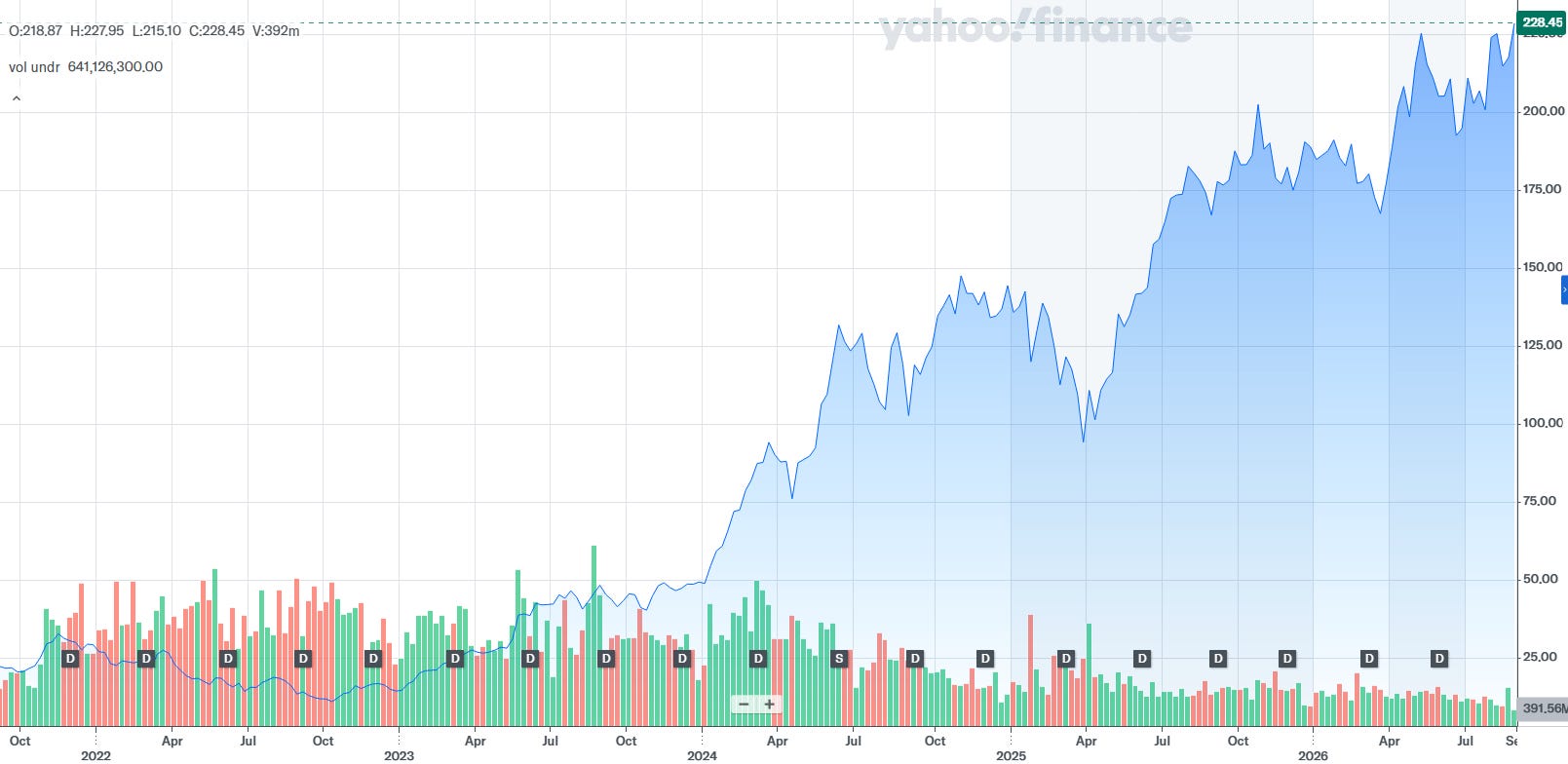
In order to Alignment Engine’s business model to make sense, there would need to be demand for AMD’s chips, not just NVIDIA’s. But aren’t all of the GPUs out there NVIDIA? Just look at their stock chart? I thought they had a stranglehold on the industry?
Well, yes and no.
NVIDIA still has the massive scale that dwarfs all of the other chip designers. They are almost 10x as large as AMD from a revenue perspective (selling these kinds of GPUs, not totally) and growing more quickly.
But signs of life from AMD are showing up. They have signed massive deals with OpenAI, Meta, Anthropic, and various other model builders. And these hyperscalers want AMD to succeed because they don’t want to be completely controlled by NVIDIA - nobody wants a sole-source provider.
There are still A LOT of hurdles for AMD to clear, and it’s by no means a slam dunk that they will eat some of the market share - NVIDIA is still the reigning champ in this space.
But the punchline is that the market is so constrained that it has opened up opportunities for NVIDIA competitors to come in and take some market share, even if the product isn’t exactly what they are looking for.
So for Alignment Engine to get into the AMD business, it’s a risk, but it does differentiate them. Most players are building around NVIDIA’s GPUs, but those are hard to get ahold of. If you had an alternative in the market, you could fill a gap that the biggest players can’t play in necessarily.
But why would Alignment Engine has expertise in AMD to begin with?
Where did Alignment Engine Come From?
Let’s look at the founding story of Alignment Engines. First, it starts with David Stanfill. He is a Kent State computer science graduate who has spent 12 years in the HPC space - High-Performance Computing. Prior to our current wave, there were a lot of reasons you would be in HPC space - simulations, weather modeling, financial modeling, etc. It was a pretty niche, esoteric part of the computing industry, until crypto mining became a thing.
Then, HPC became critically important. In order to mine for various cryptocurrencies, one needed to have a lot of high-powered compute to make it work most capital efficiently. It was a tricky problem to solve - run computing machines at a cost that made the actual ROI of collecting crypto positive.
There is a great silicon valley scene that covers this.
It’s a pretty tricky technical problem that requires deep understanding of GPUs and CPUs. And not just buying them and hooking them up to a power source either. You need to know how to cool them, rig them, write the correct software to make them work efficiently, etc.
Very similar to AI compute infrastructure.
So while the crypto mining effort for Stanfill didn’t necessarily work out4, he was able to pivot into the AI space. Instead of using their HPC experience to mine crypto currencies, they use it to be a cloud provider of training runs for AI companies.
But Why North Canton?
The biggest constraint for companies in this space today is power. There is a reason all of the press releases talk about access to power and they use the term Gigawatt. That’s an insane amount of power. That is what is need to run some of these AI training runs. Having access to that level of power is a hot button topic.
But the interesting thing about Alignment Engine is they would already have access to that power in North Canton, which is where they were based back in their crypto-mining days. One plausible explanation for Alignment’s location is that its predecessor activities already required access to inexpensive, high-density power infrastructure. That legacy could have given the company a head start as AI demand shifted the industry’s bottleneck from GPUs alone toward power and data-center capacity.
But that baked in power source that is unique to them is pretty valuable these days. So even though the talent is there to build these new age data centers and could theoretically move anywhere in the world, they are staying in North-Central Ohio.
Why $500M?
Now they are merging with the Volato Group (NYSE: SOAR). But the transaction is pretty wonky. Alignment’s shareholders (of which I don’t think there are many) own 95% of the merged entity. Volato Group shares, pre-transaction, weren’t worth all that much - way less than $500M. So the $500M number isn’t even a verifiable number. Are they really worth $500M? It’s hard to say. That number is from marketing materials and has yet to be born out in public markets.
Remember: price is what you pay and value is what you get.
The merger looks like a really weird SPAC. In other words: Alignment Engine is effectively going public via reverse merger.
The deal isn’t totally done yet, so who knows how the market will react when it goes through, but someone somewhere thinks their strategy is worth taking to the great financial weighing machine of the public markets.
On top of all of this, Alignment Engine signed a lease this past month of a data-center. We don’t know where exactly. It’s very likely that it is not in the current strip mall office park that Alignment Engine currently works out of. Which means they are an infrastructure-construction-buildout away from achieving their business aims.
They state that they have 154 MW of energy today5 on their way to 480 MW in the future. 154 MW is the rough electricity equivalent of 130K US homes per year. Whereas 480 MW is 400K homes annually. That’s not small potatoes. CoreWeave, the massive GPU renter we previously discussed, has company-wide capacity of 1.5 GW or 1500 MW. In the past year, CoreWeave has added 500 MWs.
To put this into financial terms, let’s assume that Alignment Engine can get to the 480 MW capacity, and they get to 70% utilization on that full capacity. AMD says its MI355X rack-scale design can run around 125 kW per 64-GPU rack. Now suppose, purely illustratively, Alignment eventually operated 150,000 GPUs and generated an average realized value of just: $2 per GPU-hour.
150,000 × $2 × 8,760 hours × 70% = $1.84 billion in annual compute revenue.
That might be worth $500M!
But there’s a long way to go there.
Scale that down to the 154 MW available today and that number comes in at $589M annually, roughly. It’s hard to say what the EBITDA margin profile would be here since most of the public companies are spending a CRAZY amount of money to keep up with demand and their income statements are all out of whack.
I am not an expert on data center finance - those numbers could be totally bunk. But I do think they represent the directional scale of what is trying to be achieved here. The point is the $1.84. The point is the “billion” that comes after it.
Ultimately, the race for data centers and compute has led AI companies to whatever providers they can get it from. And the chaos that is the chase for more compute capacity has opened the door for upstarts like Alignment Engine to take a crack at the market. The team has some really interesting backgrounds - they aren’t johnny-come-latelys. Maybe they can make it work.
But to be sure, there is still a lot of work to be done. Likely need financing to build out the infrastructure further (maybe billions of dollars), and they need access to more talent than they normally do to complete this build out. PLUS they have to find someone to actually buy the compute capacity. That seems like a decent bet today, but who knows how that shakes out in the long term.
Either way, I am glad people like the fine folks in North Canton are taking swings like this.
Everyone thinks AI is going to eat the world. And that’s a pretty incredible economic implication. So the theory is that the best model is going to win. As a result, these companies are doing anything they can to make the best model - even if they aren’t entirely sure what “best” means.
Hard to pin this down in a verifiable way, but it was published by the company, so willing to take them at their word.
ACCORDING TO COREWEAVE
There is a filing for bankruptcy, but definition of “work out” in crypto is up in the air.
Access to? Actually available? Currently in use? It’s really hard to say.