

Why Does Cincinnati Have an Open?
Tennis and Talent

Disclaimer: Newsletter and the information contained herein is not intended to be a source of advice or credit analysis with respect to the material presented, and the information and/or documents contained in this website do not constitute investment advice. Opinions contained within this letter are my own and not those of my employer.
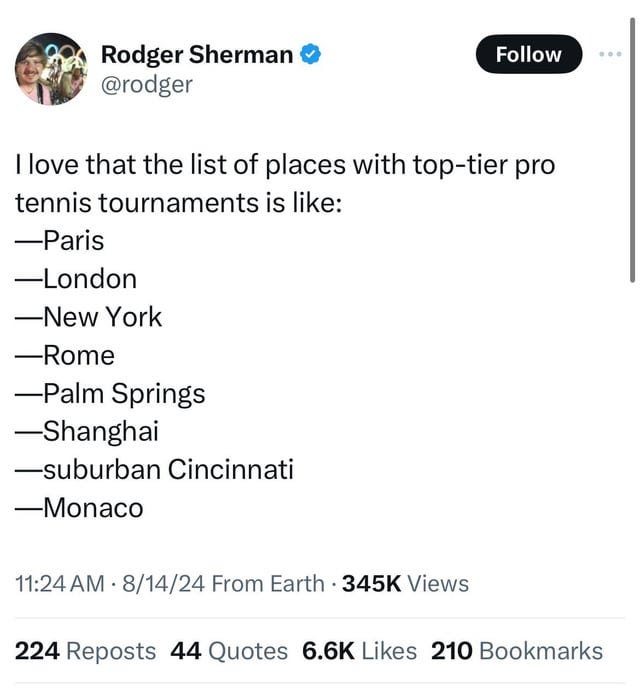
Writing a blog called How to Win In the Midwest means that I should spend some time dissecting Roger Federer. A Swiss professional tennis player, most well known for triumphs in London, New York, Australia, and even France. But also, Cincinnati, Ohio.
He won 8 times at Wimbledon. 6 times at the Australian Open, 5 for the US Open. The non-slam tournament where he has the most titles: The Cincinnati Open, with 7, spanning from 2005 to 2015. For a decade from 2005 - 2015, you had a far better chance of seeing Roger win the Cincy Open (then called the Western & Southern) than seeing literally the rest of the field win the event. He was dominant.
“But why did a guy like Roger spend time in a place like Cincinnati” is a question frequently asked by the casual tennis fan.
The Cincinnati Open is a Masters 1000 event. That is the highest tier for both Men’s and Women’s tours (technically the WTA has a different title, but it’s the same idea), other than the grand slams. It has a huge purse for pros to play in (~$16M between men and women) and it has an extremely coveted spot on the calendar - right before the US Open. It is the ultimate hard court tune-up before the last Grand Slam of the calendar year. If you want to be in shape and ready for the US Open, you have to play in the Cincy Open (22% of winners of the Cincy Open go on to win the US Open during our current Masters era, which is pretty remarkable).
But that still doesn’t really answer the question of why the Cincinnati Open is in Cincinnati. All of those things have more to do with the schedule and the way the ATP/WTA tours work. Players come to these events because the tours make it impossible to overlook.
So Why Cincinnati?
Cincinnati has history on its side. It is the oldest continuously played (same city) tennis tournament in the United States. It has been called a lot of things over the years, like the Tri-State Championship, the Western Championship, the Western & Southern Open, etc. Only recent has it been actually titled the Cincinnati Open (although not for the first time in history). It has pretty much always been the central tennis event for the Midwest.
Chicago was the center of the Midwestern tennis world for a period of time - it had a tournament called the Western Championships - started 12 years before the Cincy Open in 1887. The Western Lawn Tennis Association governed all tennis west of the Alleghenies and this was their main event. The Western Championships rotated throughout cities, however. It was not just played in Chicago, but at various tennis clubs and locations throughout the Great Lakes & Midwest. It played in Chicago, Harbor Springs, Indianapolis, Kansas City, Lake Forest, Minnetonka, Neenah, River Forest, and even Cincinnati.
While the Cincinnati Open was roughly similar to the Western Championships pretty soon after the Cincy Open was founded, the difference was that the Cincinnati Open was focused on one community and one rabid tennis fanbase. The Cincy Open changed venues, but always stayed well within the confines of the Greater Cincinnati area. It was Cincy’s tournament (yes, Mason is part of Cincinnati… the metro region at least).
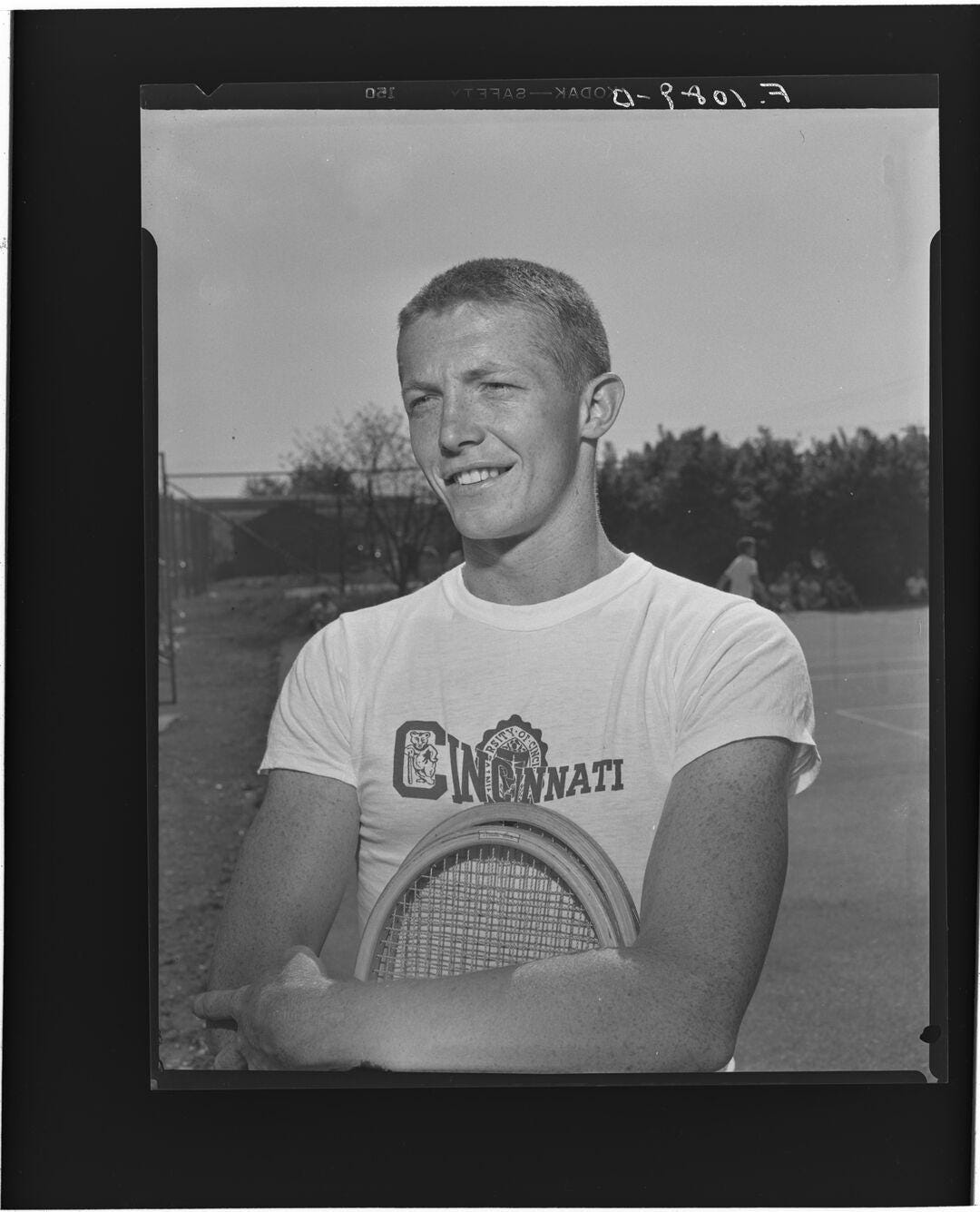
Cincinnati started on firm footing when the tournament got started. Cincinnati has a strong historical tennis culture. Many greats of the game, pre-open era, have come from this part of the country, like Tony Trabert, who was the world number 1 player, won five grand slam singles and doubles titles, was also the captain of the Davis cup and a member of the International Tennis Hall of Fame. In 1955 he won the French Championship, Wimbledon, and the US Championship (3/4 slams). He grew up at the Cincinnati Tennis Club and went to Walnut Hills High School. Also, this absolute legend played basketball (as well as tennis) at the University of Cincinnati.
There was also Nat Emerson (early amateur who reached number 7 in the world in 1908), Bill Talbert (won a boatload of doubles slams, mentored Tony Trabert), Reuben Holden (NCAA singles champion in 1910), among many others.
Cincinnati produced a ton of elite amateur era talent in the early twentieth century. The city, for whatever reason, just liked tennis.
Maybe this was because the Cincinnati Open was so prominent that it encouraged more folks to play. Or maybe because Cincinnati itself was so affluent during that period that it was able to play an affluent sport like tennis. Or maybe there is a talent flywheel that occurs - great begets more great.
But either way, it is undeniable that during the Amateur era (pre 1969), Cincinnati had a strong tennis culture. This helped foster a strong tennis tournament. It was very early in the game, it is the 10th oldest still running tournament in the world for professionals, including Wimbledon, the US Open, the Canadian Open, The French Open, The Hamburg Open, Generali Open Kitzbühel, and the Monte-Carlo Masters. And most of those pre-date Cincy by only a couple of years. And by the way, Cincinnati is the only one in North America listed above city in its original city.
And during an era were amateurs were the primary focus of tennis, that meant the tournaments, outside of the grand slams, were a cottage industry. They only really existed if the region had a very strong interest in the sport.
It was early to the game and it had a lot of regional support from a strong tennis culture, not just in Cincinnati, but throughout the Midwest. But having a prestigious tournament in the amateur era was not that much of challenge.
But the game of tennis has changed a lot since 1899.
In 1969, the open era began. There were a lot of tournaments that were traditionally amateur-only (like the Cincy Open), that struggled to make the transition - or elected to forgo the transition altogether. While amateur and professional tennis aren’t technically different - the court dimensions and rules are the same - the way that they were marketed was pretty different. And the kinds of crowds they would attract. And suddenly these tournaments were focused on making money, not just prestige.
(Although the term Scamateur Tennis was coined during the amateur era because there was a lot of under-the-table money movements, so it’s not like everything was suddenly drastically different.)
This meant that everybody had to rethink how tournaments were managed. They were economically motivated events. If you were a prestigious amateur tournament and you wanted to remain as a prestigious event, you had to figure how to accommodate the pros, including putting together a prize purse. Not only that, but the calendar was a lot more complicated. There were a lot more prestigious tournaments than there are today and they had to fight for a place to be on the calendar.
Being a tournament no longer meant having to attract good regional amateurs and having a well-respected club. It meant having a big purse (bigger than the other guy’s) and having facilities to attract great talent. There was a war for professional talent and there was no governing body to provide any guardrails. Everyone was trying to figure out how to stay relevant.
For the Cincinnati Open, this transition was hard.
Until 1972, the tournament was still held at the Cincinnati Tennis Club, a small venue for the pros. It couldn’t compete with professional expectations at the time, nor for the attention of the local fans.
They then had to move to the Cincinnati Convention Center (after being nearly dropped from the calendar altogether) and played indoors in 1974.
From there, in 1975, they moved to Coney Island in Cincinnati. This was to expand capacity. But Coney only had one real tournament court, which made logistics challenging.
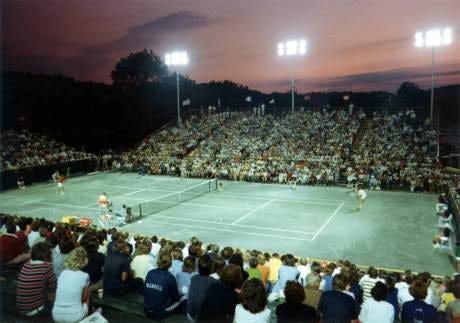
By 1979, the tournament finally made its way to Mason, where it resides now.
But this wasn’t done in a haphazard manner. The real reason the Cincinnati Open was able to survive was Paul Flory.
If you have spent any time around Cincinnati tennis, you have certainly heard Paul Flory’s name before. He was the chair of the tournament from 1975 until his death in 2013. He was also the reason the tournament was able to stay alive at all. It is not a coincidence that the year they find a decent site to play the tournament (Coney Island) was the year he started. Nor is it surprising that shortly after he took over the reigns did they end up with a permanent address with facilities all to themselves in Mason.
He was the driving force behind the tournament maintaining relevance and making the transition.
Flory was a retired P&G executive who had been involve loosely with the tournament for years.
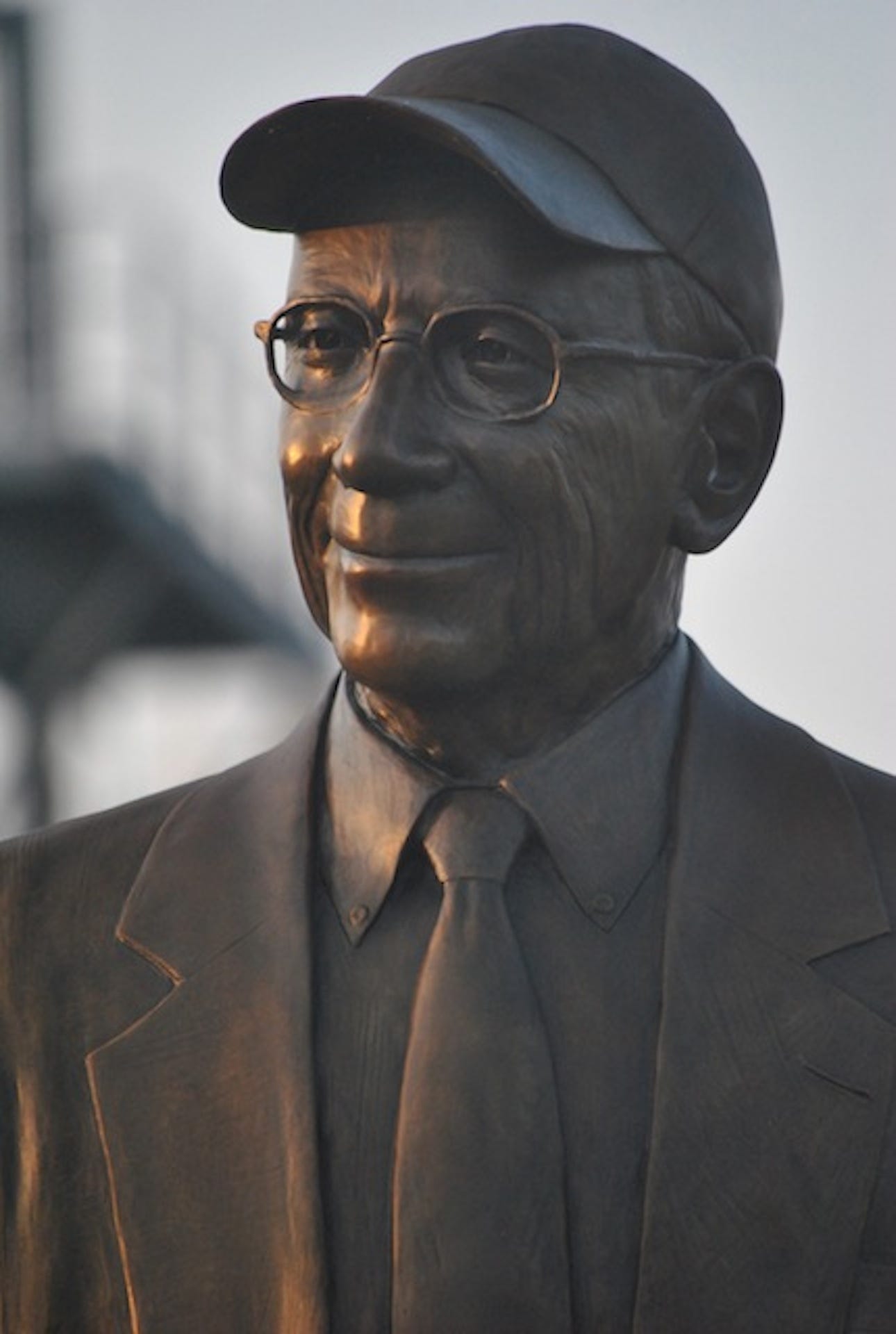
The wild west of pro tennis in the 70s and 80s needed a cowboy to wrangle it in. That was Flory’s job, specifically for the Cincy Open. He was a retired P&G Exec - having spent most of his time in the oral care business - Crest, things of that nature. When he took over in 1975, he famously started to treat the tournament like a professional business. Which might sound obvious in retrospect, but was probably a pretty radical idea in 1975. The tournament was literally anti-professional 7 years prior.
Not only did he professionalize the organization of the tournament, he also realized that the event had potential as a professional event broadly - he was early in recognizing the business and brand potential of the Cincinnati Open. His network connections were drawn into the tournament and made it a place for the Cincinnati / Midwest business community to gather and host VIPs. It was also able to attract locals to be part of the fabric, bringing in a big volunteer base.
And, like any good brand guy, he focused on making sure the tournament had a strong brand, specifically with the players. This was a key insight from Flory - treat the players like the pros they are. Make sure that they love the event and they will want to come back. If good players come to the tournament, Flory thought, then he would have no trouble filling seats.
He was 100% correct on that assumption. He did things like provide all players with a courtesy car in 1979 for when they needed to get around. That was a pretty novel concept - but also something that would have just made sense to a brand exec at P&G. Treat talent well.
Ironically, a lot of the tournament directors at the time were retired players themselves. Flory was a pro, but not at tennis. This allowed him to think outside of the box from the rest of the tennis world and make the Cincy Open stand out.
A quote to back this point up from 2-time Cincy Open Champion Michael Chang:
“When Paul needs something, the players are more than happy to do it,” Chang said, “because they know if there’s anything the players need, Paul’s willing to go out of his way to take care of it.”
In 1979 Paul Flory helped make the transition to Mason, where the Cincinnati Open could have a single purpose tennis facility, with plenty of room for expansion. Which is exactly what they did. They invested heavily in the facility and it grew over time.
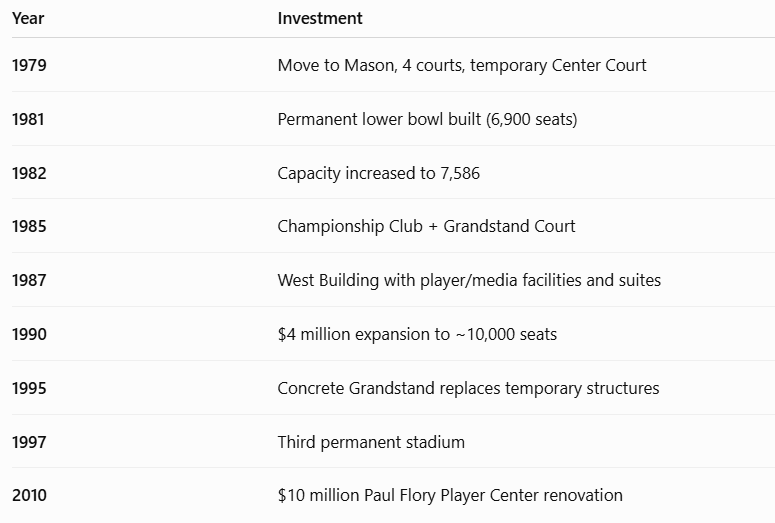
It’s hard to know exactly how much capital was invested into the Mason site. There is a $35 million number that I have seen quoted a couple of times, but has been hard to verify. They did all of this to continue to attract the best players, through the vision of Paul Flory.
And in 1990, when the ATP tour was formalized, creating a more concrete tennis calendar, Cincinnati got one of the best spots on the calendar and one of the best purses from the ATP. It was a Masters 1000 tournament, making it nearly impossible to skip for pros.
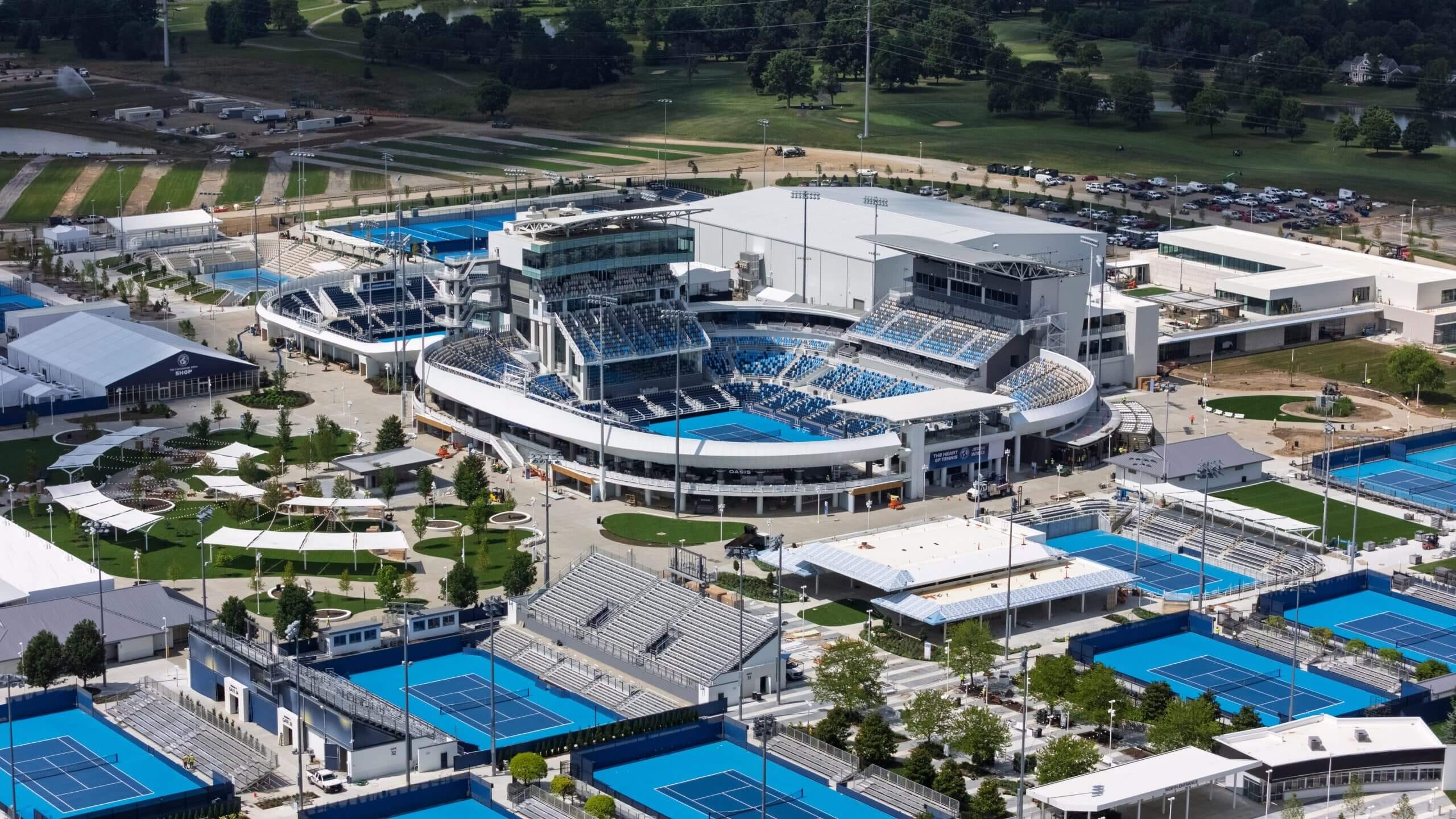
It rode the wave of being a Masters 1000 tournament for a long time. Then, in 2022, the tournament was sold to new owners, Beemok Capital, family office of billionaire Ben Navarro. They paid approximately $270 million and put an additional $260 million into the facilities (along with help from local municipalities and sponsors).
There is a broader discussion about the most recent sale, but the point is that in the last 2-3 years, the tournament changed hands and recommitted to Cincinnati.
So the question remains: why is it here in the first place?
The answer is, as is almost always the case: talent.
The tournament stuck around for 70 years until the open era because of prestige and how much Cincinnati cared about tennis. But it likely could have died once the Open Era began.
It didn’t die because of Paul Flory. But he wasn’t just some mythical creature. He was exactly the kind of talent that built Cincinnati: P&G brand supremacy.
Sport was turning itself on its head. The NFL-AFL merger had just occurred, the NBA merger was happening, media rights were starting to become a thing, and the American consumer was now considering sports as something to be taken seriously (beyond as a leisure activity).
At a time when sports were becoming brands and big business, it took one of the best brand minds in the game to come and rebuild the Cincinnati Open into the juggernaut it is today. And P&G was where the best brand thinkers resided. So it’s no wonder that the city produced exactly the right person to turn the tournament into what it is today.
The Cincinnati Open took advantage of the cities greatest strengths, brand management talent, to turn itself into a real, lasting brand.
Favorite Cincinnati Open by-the-numbers:
9: one of 9 Masters 1000 tournaments each year
126 million: Its television audience exceeds 126 million viewers worldwide.
285,571: record attendance in 2025
$12 million: to Cincinnati area charitable organizations
Midwest Deal Roundup
This is a section on some of the most interesting deals (not just venture) done in the Midwest in the last ~week.
🏗️ Prysmian to acquire Atkore for $3.8B
📍 Harvey, Illinois
What they do: Atkore manufactures electrical infrastructure, safety, and construction products, including conduit, cable, installation accessories, metal framing, mechanical pipe, perimeter security, and cable-management systems.
The deal: Prysmian (MIL: PRY) entered into a definitive agreement to acquire Atkore (NYSE: ATKR) for approximately $3.8 billion. The combination is intended to expand Prysmian’s North American electrical-infrastructure offering and increase its exposure to electrification and data-center investment.
⚛️ IonQ acquires SkyWater Technology for $1.952B
📍 Bloomington, Minnesota
What they do: SkyWater Technology operates a U.S.-based semiconductor foundry providing foundational-node manufacturing, advanced technology development, semiconductor fabrication, and advanced packaging services.
The deal: IonQ (NYSE: IONQ) acquired SkyWater Technology for approximately $1.952 billion. The acquisition gives IonQ greater control over its domestic semiconductor manufacturing supply chain as it scales its quantum-computing platform.
🩺 Kohlberg & Company and Montagu acquire Ingenyx for $1.5B
📍 Plymouth, Minnesota
What they do: Ingenyx manufactures medical-device components for healthcare OEMs, including diagnostic and interventional catheters, balloon catheter systems, medical tubing, wires, sutures, and bioabsorbable materials.
The deal: Kohlberg & Company and Montagu Private Equity acquired the Teleflex subsidiary through a $1.5 billion leveraged buyout.
🏗️ Francisco Partners to acquire Command Alkon for $715M
📍 Hilliard, Ohio
What they do: Command Alkon develops software and hardware for construction-material producers, helping automate batching, dispatching, production, quality control, fleet tracking, and back-office operations.
The deal: Francisco Partners entered into a definitive agreement to acquire Command Alkon through an estimated $715 million leveraged buyout. The transaction values the company at an estimated $1.3 billion.
🏦 Esquire Bank acquires Signature Bank for $348M
📍 Chicago, Illinois
What they do: Signature Bank operates a commercial banking platform offering deposit accounts, commercial and consumer lending, treasury management, payment processing, and other digital and branch-based financial services.
The deal: Esquire Bank (NASDAQ: ESQ) acquired Signature Bank for $348 million, expanding Esquire’s presence in the Chicago market and adding scale to its banking operations.
🏢 DHS acquires CoreCivic’s Leavenworth facility for $238.4M
📍 Leavenworth, Kansas
What they do: The acquired asset is a 1,033-bed Midwest Regional Reception Center located in Leavenworth, Kansas.
The deal: The DHS Science and Technology Directorate acquired the facility from CoreCivic (NYSE: CXW) for approximately $238.4 million.
🩺 Hinge Health to acquire Cylinder Health for $105M
📍 Chicago, Illinois
What they do: Cylinder Health operates a virtual-care platform focused on digestive health, connecting patients with personalized, clinician-backed gastrointestinal care and support.
The deal: Hinge Health (NYSE: HNGE) entered into a definitive agreement to acquire Cylinder Health for $105 million. The companies plan to combine Cylinder’s clinical capabilities with Hinge Health’s AI-powered care platform.
💊 Blend raises $12M
📍 Columbus, Ohio
What they do: Blend develops a pharmacy prescription-management platform for medical clinics, telehealth providers, and independent practices, offering prescription tracking, automated invoicing, custom packaging, dashboards, and e-prescribing capabilities.
The deal: The company raised $12 million in early-stage venture funding from undisclosed investors.
☁️ RWX raises $12M Series A1
📍 Columbus, Ohio
What they do: RWX develops a cloud-based continuous-integration and continuous-delivery platform designed to help software-development teams build, test, and ship code faster.
The deal: The company raised a $12 million Series A1 led by Hyde Park Venture Partners, with participation from the Ohio Capital Fund, Quiet Capital, R1 Capital, Bryan Johnson, Kohsuke Kawaguchi, Duval Ventures, and other investors. The financing valued RWX at $62 million post-money.
🎵 Samply raises $3.33M
📍 Stevens Point, Wisconsin
What they do: Samply develops a music-collaboration application that helps musicians and audio creators organize samples, share tracks, and provide time-coded feedback during the creative process.
The deal: The company raised $3.33 million in later-stage venture funding through SAFE notes from Mairs & Power Venture Capital and other undisclosed investors.
🛡️ InnerActiv raises $3.26M
📍 Worthington, Ohio
What they do: InnerActiv develops endpoint-security software that helps enterprises monitor AI usage, identify insider threats, prevent data leakage, and manage endpoint risk across employee devices.
The deal: The company raised $3.26 million in venture funding led by Blu Venture Investors and North Coast Ventures, with participation from Bold Ventures, R1 Capital, and 71/70 Angels. The funding will support product development and expansion of the company’s direct and channel sales efforts.
💻 Image Solutions acquires RCC Business IT for $2.4M
📍 Bruce Township, Michigan
What they do: RCC Business IT provides managed IT services, cybersecurity, cloud solutions, compliance support, disaster recovery, and technology support to small and mid-sized businesses.
The deal: Image Solutions, a subsidiary of Kingsway Financial Services (NYSE: KFS), acquired RCC Business IT for $2.4 million, expanding its geographic footprint into Michigan and the broader Upper Midwest.
By the numbers
12 notable Midwest transactions
~$8.69B in disclosed transaction value
States represented: Illinois, Minnesota, Ohio, Kansas, Wisconsin, and Michigan
Illinois accounted for three transactions and approximately $4.25 billion of disclosed value, while Minnesota contributed approximately $3.45 billion across two transactions. Ohio led by deal count with four transactions totaling approximately $742 million.
This is the article I didn't know I needed to read today - and I read all of it! As a newcomer to Cincinnati (with most of my adult life in NYC) I've been wondering about this. What a powerful business story in so many ways. Thank you!