


Disclaimer: Newsletter and the information contained herein is not intended to be a source of advice or credit analysis with respect to the material presented, and the information and/or documents contained in this website do not constitute investment advice. Opinions contained within this letter are my own and not those of my employer.
Indiana manufactures 88% of all RVs produced in the United states and Canada, most of them in Elkhart, Indiana and surrounding towns. That’s a crazy number. Basically nowhere else in this country has that level on concentration on a single product that is not either (a) agricultural in nature or (b) only considered a product if produced in that region, like bourbon.
So Why does a town like Elkhart, Indiana have such a stranglehold on producing recreational vehicles like this? Why hasn’t this been offshored? How are they able to find the talent? Is this a good thing?

Why RVs?
The Great American Road Trip is a pretty Midwestern and American thing to do. It’s in the founding fabric of this great nation, taking a wagon and moving your entire family across these great states. RVs are not used for moves per se, but they are an extension of that idea: “This country is big, we have a lot of opportunity, wonder, splendor, and diversity. Let’s get out on the open road and see everything in our contiguous backyard.” Like a lot of things that are in the leisure category today, it is a form of cosplay of our historical roots.
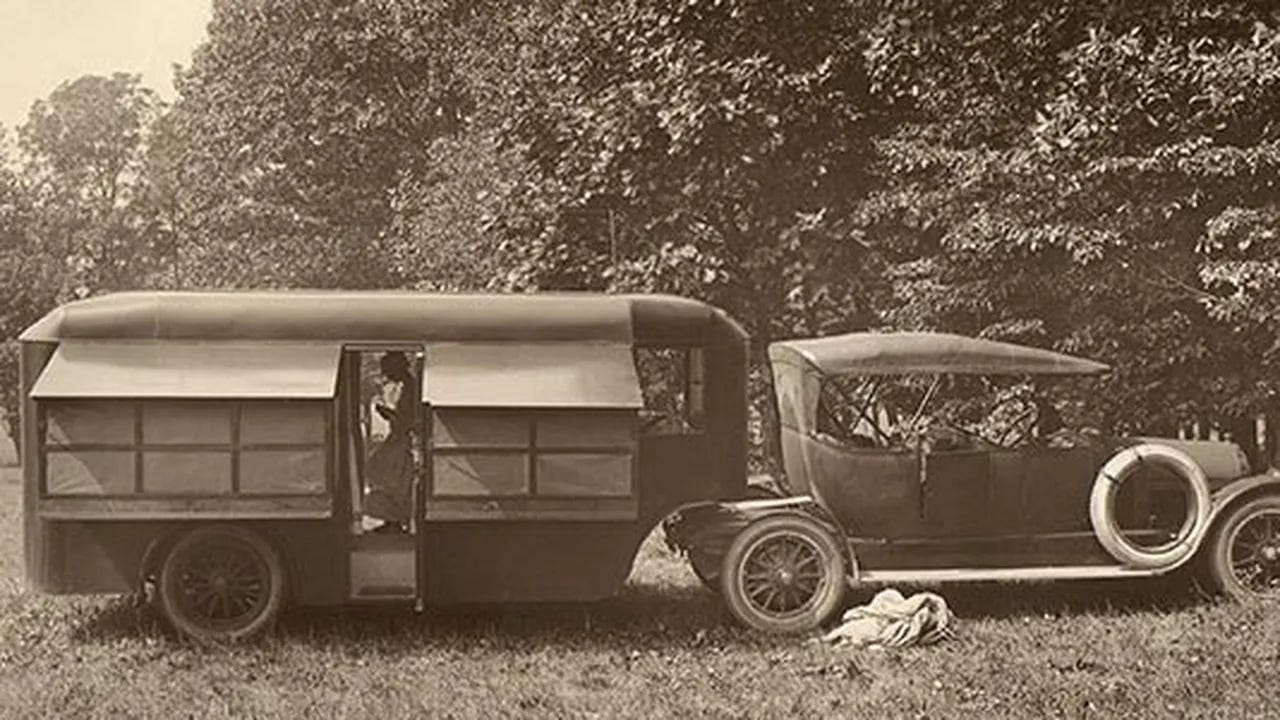
Nevertheless, at some point we did transition from covered wagon and the Ingalls family to RVs. That transition period included modernized wagons pulled by automobiles of the time. The RVs we know today started out mostly as retrofitted trailers from a bygone era.
Then in 1967 Winnebago introduced “America’s first family of motor homes,” five models from 16 to 27 feet long, which sold for as little as $5,000. Seen below, this is when and where RVs actually got started.
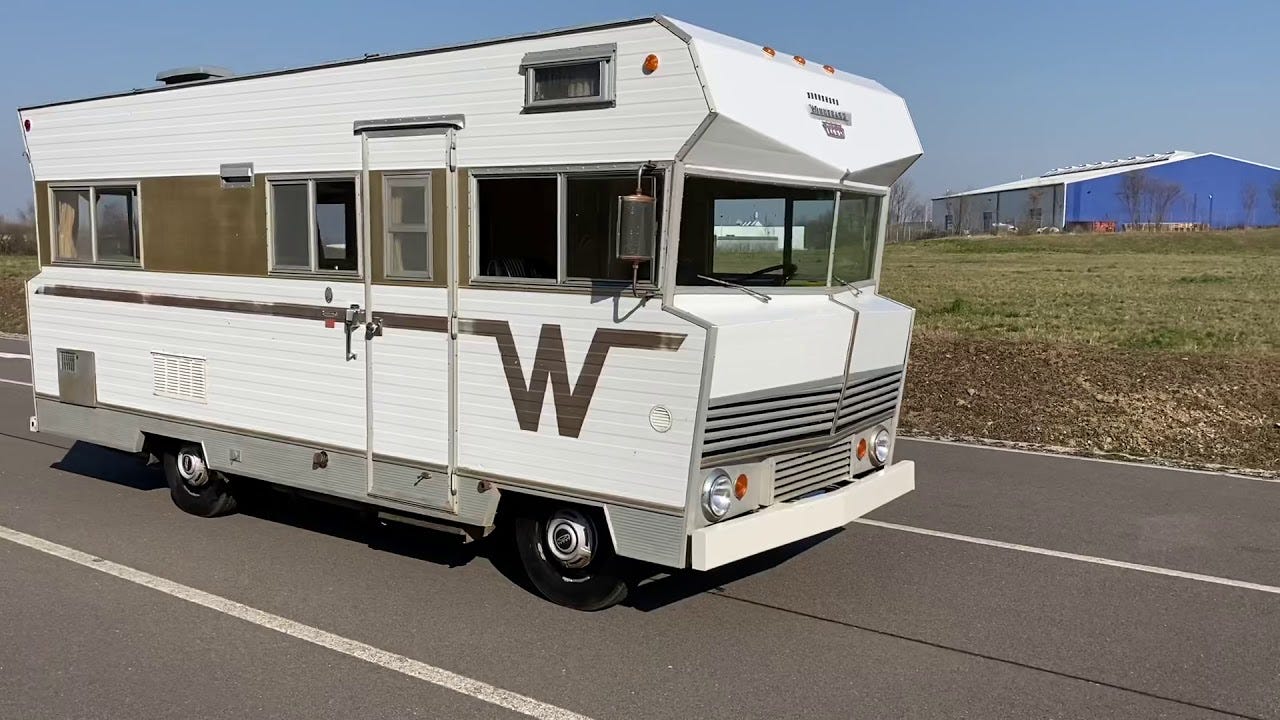
While the Winnebago was part of the evolutionary road for RVs, it could also be viewed as a great leap forward. From there, as engines improved and technology improved in the 60s, 70s, and 80s, so did the RV. Not only that, but the improvements of the interiors of a RV mirrored the improvements of the American consumer class broadly. You have a convection oven at home? You bet they are going to put a convection oven in your RV.
[Interestingly enough, Winnebago is not based in Northern Indiana. They do, however, have a huge manufacturing presence there. Why? Because when then buy other RV brands like Newmar and Grand Design, those folks are HQ’d in Northern Indiana.]
As American consumer spending power rose and time for leisure improved, so did the demand for RVs. They were viewed as a luxury item for a quintessential American vacation. Investments into the vehicles and designs followed.
When you look at the list of innovations and breakthroughs that were happening during the growth years, most of them came from companies in Northern Indiana. Lightweight aluminum framing, fifth-wheel RVs as a major category, freshwater and waste holding tanks, refrigeration, indoor toilets and showers, air conditioning, and many other residential luxuries are all due to companies in Northern Indiana. While the region didn’t invent the RV, it basically invented the modern version of one.
And with that, RVs got more and more complicated to produce. RVs are far more personalized vehicles that most automobiles. When you go to buy, you aren’t just looking at make and model, but different floor plans and dozens of different decisions to be made about the interior. In order to deliver such complicated, sku-unique products, a company needs to have an extremely strong manufacturing process and supply chain. The know how to do that increasingly concentrated in Northern Indiana.
The region’s growth in the category has continued throughout the years as consumer demand has increased. the 90s and aughts were times of strong consumer spending power and higher demands on consumer products. That just made Northern Indiana’s edge even more powerful.
But the thing about RVs is that they are particularly cyclical. When recessions hit, RVs REALLY get hit. You can tell from the chart below when there have been negative economic periods.
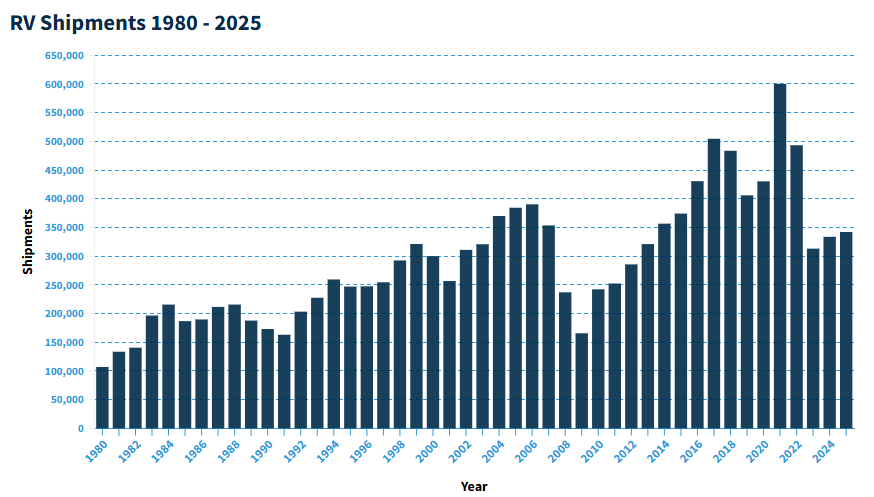
But the interesting period is the last five years. 2021 saw a tremendous uptick, followed by a precipitous decline in 2023 and 2024 (growth now picking back up). But if you look at most metrics, it’s not really recession season (or it hasn’t been from 2022 - 2024). It was a weird time economically, sure, but I think a lot of RV purchases got pulled forward and impacted future sales dramatically. Plus, money was free - ZIRP baby. People bought all sorts of stuff.
But again, why Elkhart, Indiana?

So while Northern Indiana had a lot to do with the proliferation of advancements in the RV space, why were they in position to do that in the first place? Northern Indiana is not the obvious place to spend time RVing - the state only has one National Park within its borders. (most RV trips actually aren’t to National Parks, but they aren’t to Indiana either).
Also, Indiana buys and registers a lot of RVs, but it’s not the number one place people are buying RVs. It doesn’t have some special RV culture, even compared to some of it’s peers. Ohio and Michigan each tend to buy more total RVs and Minnesota and Iowa have larger RV purchases per capita than Indiana. The RV consumer pull in Indiana is not so strong that they have to be built in the state in order to satiate that clientele.
Northern Indiana builds practically all of the country’s (and by proxy, the world’s) RVs because they have all of the component parts required to do so. Building a vacation home on wheels is no small feat. Building anything with a big engine is not a super simple endeavor. Throw in that convection oven and the other niceties of home and it suddenly becomes a beast of a task to pull off.
So you don’t just need the auto or engine manufacturing skills that Detroit possesses. You also need furniture manufacturing, metal fabrication, trailer and mobile home know-how, and just generally skilled tradespeople accustomed to assembling products by hand.
You need all of those skills (and then some) and you need to figure out how to integrate them all most effectively. Knowing how to fit all of these pieces together like a puzzle is a lot different than knowing how to make a convection oven. Appliances are hard, but try making them such that they work on the highway and camped in a National Park.
This all has to start somewhere and the fundamental evolution of RVs is that they started as trailers. But Northern Indiana started building travel trailers. Milo Miller founded the Sportsman Trailer Company. By 1939 they had become the largest trailer manufacturer in the country. That’s cool, but not that crazy since it was still a relatively niche industry.
And the whole reason Wilbur Schult (who bought out Miller early on in the story) was involved in this business at all is because he went to the 1933 World’s Fair in Chicago and saw trailers displayed prominently.
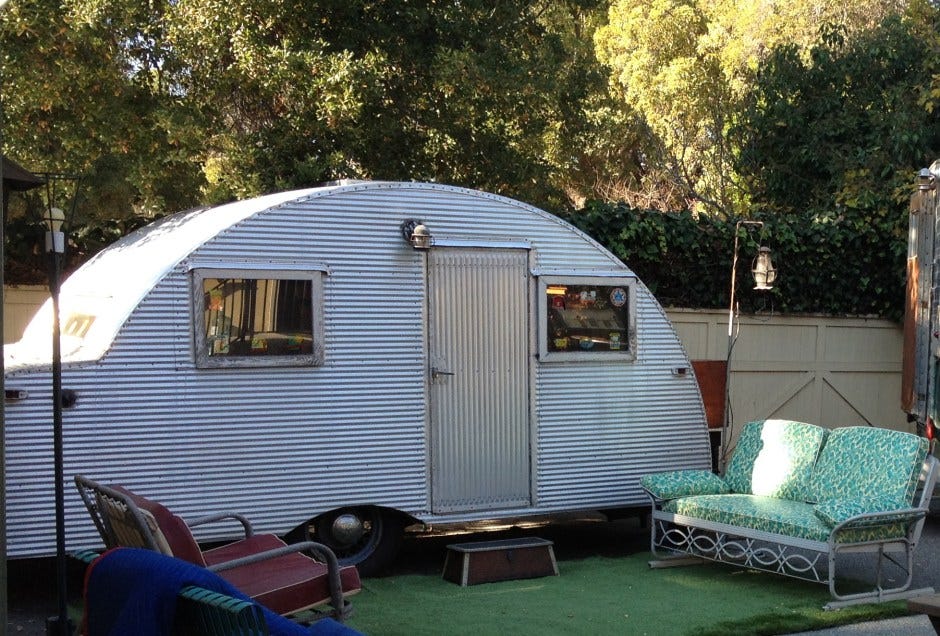
Why was Sportsman so successful early on in their story? It’s hard to say exactly. But their early success begot further investment into that industry. (see above for various innovations from the region).
Ultimately Elkhart was a great place to get started building a business like this. You have access to railroad corridors through which tons of materials and supplies could be transported (steel, lumber, rubber, etc.), access to skilled trade, and access to engineering know-how from nearby automotive manufacturers and parts suppliers.
The Talent Equation
But despite be in a good starting position from a natural resource perspective, what really mattered was their access to talent. Elkhart wasn’t a blank slate, which is important. Before it was the RV capital of the world, Elkhart was producing band instruments in large quantities. It was even previously known as the “Band Instrument Capital of the World”. Making instruments requires skilled tradesmen and having something like that already exist is extremely helpful when finding talent to get things started.
Northern Indiana already had great woodworking cultures (see: the Amish). Same could be said for welders or electricians or plumbers or furniture builders. Those things are not unique to RVs or Northern Indiana, but they are necessary. They can all be found in other places but are they always in the same place? That’s harder to tell. But Elkhart needed all of them and they needed that talent to be applied specifically to RVs.
It’s hard to find statistics that support that those skilled trades existed in 1939 or 1952, but if you look at the present situation it becomes more obvious. Plus, there is no way they would have been able to produce the RVs they have without these skilled workers. Meaning they either already existed in droves, or something about Elkhart RV manufacturers made it possible to recruit them there early on.
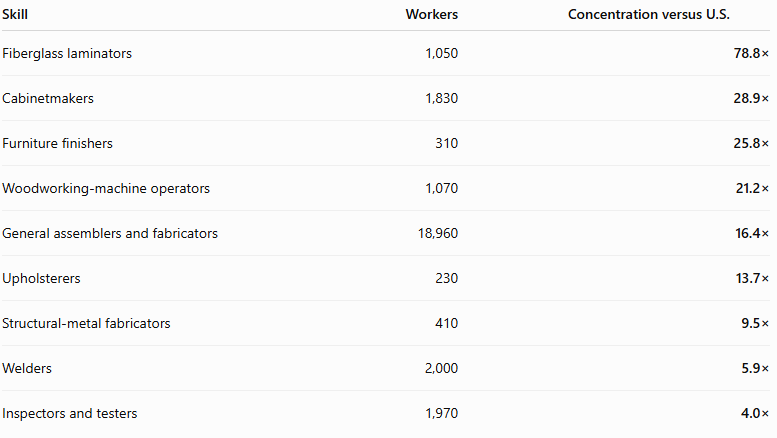
Regardless of what the region started with (likely pretty strong from other various niche industries), they very quickly invested heavily into the right kind of talent. And then it just snowballed from there.
And, what’s more, you don’t really have a ton of competition for talent either. Elkhart is RVs. RVs are Elkhart. So as the industry gets more complicated - floorplans become more complex, appliances become more unique, consumer behaviors become more demanding - then the talent needed to fulfill these complications start to congregate in one place. Because at that point it’s not just about having good skilled trades, but about having good skilled trades who uniquely understand the RV. And there is nothing like on-the-job training.
I am reminded of one Paul Graham’s most interesting essays about cities and ambition. He talks about how different cities whisper different ideas - New York respects money, Silicon Valley respects power, Boston respects intellect, etc. Elkhart, Indiana, if I were to guess, respects RVs. It is in the very fabric of what they do.
They don’t just make RVs, but they have a lot of supplier components based in the region as well - companies like Lippert who does $4.1 billion in revenue, employs 14,000 people, and makes chassis, frames, steps, and other component parts for RVs.
I met someone last night at a Reds game and she told me she was from Northern, Indiana. I told her how I was writing about Elkhart and she told me her dad was an expert at window installations in RVs, without missing a beat. She was proud of him. Which is fucking cool - there are far worse things for a city to care about than taking pride in your work.
And this is ultimately the punchline here - how did Elkhart, Indiana become the only place to build RVs? Because it was the only place to build RVs. It took an advantage of what little lead it had and leaned hard into it. The Power Law applies to industry expertise as well.
Being in the RV business in Elkhart is a no brainer. If you grew up there, there is a pretty good chance someone in your family has that experience already. So it’s like learning a second language in your home - you just know inherently how certain things work because it gets talked about so much and ingrained in you from an early age.
But it’s not like this is a pure apprenticeship model either. There is also the social pressure of people in the town knowing that RVs are a good way to make a living because they have seen other people make a good living that way as well. If you don’t work in the RV business, you might have a hard time explaining what you do at your high school reunion. While that doesn’t sound like a big deal, social pressures like that build up over time. Humans like being a part of the in-crowd.
On top of that, it is also an extremely powerful network to be a part of. What happens if you don’t like your current job at one RV manufacturer? Great news - there are a dozen others that you can go work for that put your skill sets to good use AND appropriately value your skills because they know how to. Career mobility is important for general economic mobility and stability. Things don’t always go your way - having a backup plan doesn’t hurt.
Plus, competition for talent generally makes companies better because they have to become the kinds of places that top talent wants to work. That includes having strong perks and benefits, but also just being a great place to grow and develop. High performers want to work with other high performers and they want to work for high performing companies. High performers are rarely comfortable with mediocre growth.
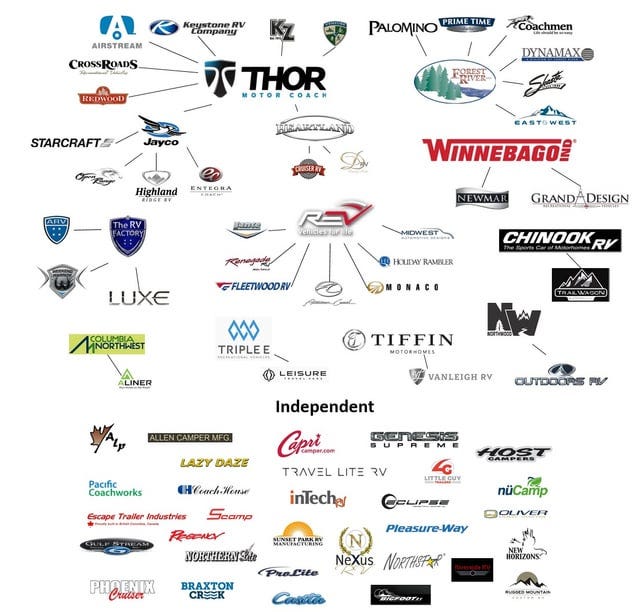
It pays to have a lot of competitors and players in your backyard.
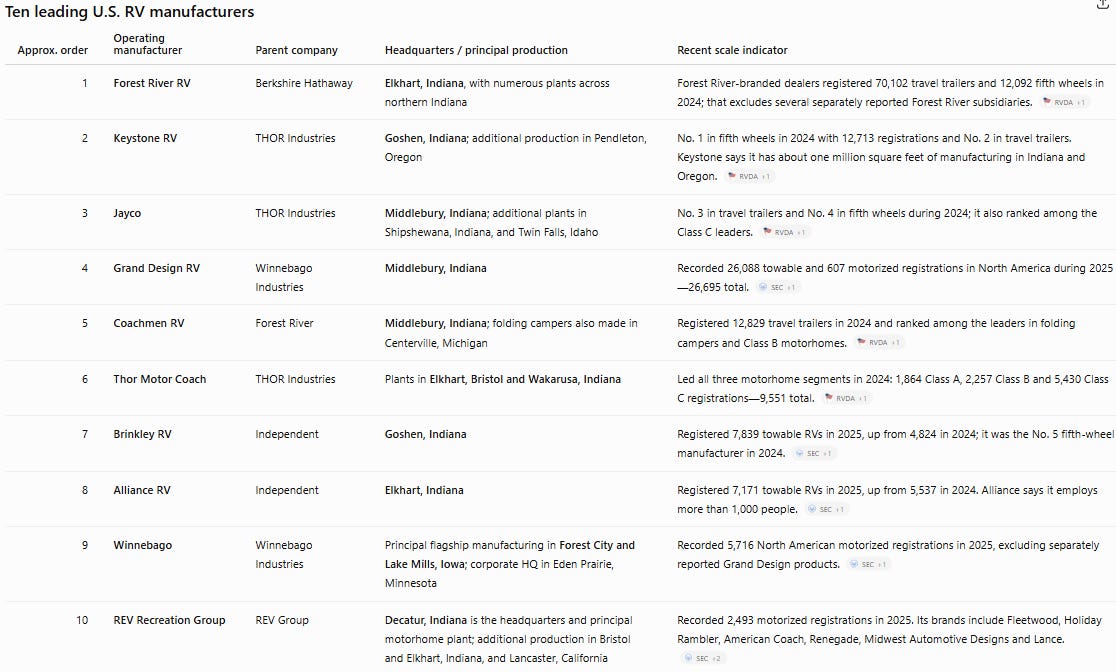
If you have the specialized skills required to build an RV, the question stops becoming why would you live in Northern Indiana and becomes why wouldn’t you? All of the opportunity is there? All of the best people to learn from are there? That is where your skills are most valued.
And, as history shows us, great companies are built by great talent. You can have vast resources and incredible demand and unencumbered regulations and much more, but if there are not great people, none of that will matter. People who have been there before and know what success looks like. Elkhart has it in spades.
Is this a Good Thing?
Clearly Northern Indiana is winning the RV race, but is that a race you want to be in?
As previously stated, this is a very cyclical business to be in. During the Great Recession, Elkhart’s economy got beat up. They had one of the worst unemployment rates in the country in 2009. After President Obama got elected, one of the first places he went to to tout his economic recovery plan in 2009 was Elkhart because it was viewed as being in such dire straits. You don’t want the President (any President) showing up in your town telling you he is going to save you - that’s when you know things are bad.
And diversification is generally a good thing for an economy.
So sure, it’s a safe place to work as a RV specialist, but what if the whole of the RV industry is getting beat up? You get laid off and where do you go from there if everyone else is doing layoffs?
Also, whenever there is a social pressure like this in a single industry, you tend to run the risk of suffering from group think. This can lead to another pressure working against you when caught in an innovator’s dilemma. Innovation gets harder to exercise because not only do the people you work with think you are a crazy, but your community, who understands your industry better than they probably should, thinks you are crazy as well. Suddenly your aunt at Thanksgiving asks you why would be so stupid to take on such a risk (even if the decision made is not risky at all). Risk perception can be tainted in arenas like this one.
But what are the innovations to be scared of in the RV business? It’s hard to say, but everyone has them over a long enough timeline.
The flipside of both of those points is that the alternative is generally worse. Having no industry expertise in a town typically spells doom for that town eventually. And great leaders in industry know how to take advantage of the boom times to set them up for success during busts.
Plus, Elkhart has reinvented itself once. Who is to say they can’t do it again?
Midwest Deal Roundup
This is a section on some of the most interesting deals (not just venture) done in the Midwest in the last ~week.
🤝 Grant Thornton to acquire CBIZ for $2.99B
📍 Cleveland, Ohio
What they do: CBIZ provides accounting, tax, financial advisory, employee benefits, insurance, and other professional services to middle-market businesses and organizations across the United States.
The deal: Grant Thornton, backed by Ottawa Avenue Private Capital, New Mountain Capital, La Caisse, and Crescenta, entered into a definitive agreement to acquire CBIZ (NYSE: CBZ) through an estimated $2.99 billion leveraged buyout.
⚙️ TransDigm to acquire Prince & Izant for $1.066B
📍 Cleveland, Ohio
What they do: Prince & Izant manufactures brazing alloys and precision metal-joining products used in the automotive, cutting-tool, oil and gas, electrical manufacturing, and other industrial markets.
The deal: TransDigm Group (NYSE: TDG) reached a definitive agreement to acquire the company for approximately $1.066 billion.
🛡️ Tiptree to acquire Universal Shield Insurance Group for $100M
📍 Waterford, Michigan
What they do: Universal Shield operates a commercial property and casualty insurance business offering products including commercial property, general liability, transfer bonds, and other specialty coverage.
The deal: Tiptree (NASDAQ: TIPT) reached a definitive agreement to acquire the company for $100 million, further expanding its specialty property and casualty insurance operations.
🚚 Freehand raises $75M
📍 Chicago, Illinois
What they do: Freehand develops an AI-powered spend-management platform that helps enterprises audit freight and supply-chain expenses, identify overbilling, recover credits, and automate dispute-resolution workflows.
The deal: The company raised $75 million in venture funding in a round co-led by Battery Ventures and NewRoad Capital Partners, with participation from NewBuild Venture Capital and PSP Partners.
🌾 Boa Safra raises $46M
📍 Manning, Iowa
What they do: Boa Safra provides tax and scientific-reporting services that help farmland, ranchland, and timberland owners identify and document potential tax deductions associated with nutrients in their soil.
The deal: The company raised approximately $46 million in later-stage venture funding from undisclosed investors.
🩺 Healia raises $18M Series A
📍 Columbus, Ohio
What they do: Healia develops a health reimbursement arrangement platform that helps employers administer healthcare benefits and reimburse employees for eligible individual and family medical expenses.
The deal: The company raised an $18 million Series A led by 111 West Capital, with participation from GoAhead Ventures, Pioneer Fund, North Coast Ventures, First Round Capital, and Y Combinator. The financing valued the company at $57 million post-money.
📊 BrandRank.AI raises $3M seed round
📍 Cincinnati, Ohio
What they do: BrandRank.AI develops software that monitors how brands appear across generative-AI answer engines, providing visibility analytics, brand-intelligence tools, and digital-reputation monitoring.
The deal: The company raised $3 million in seed funding led by Grit Capital Partners and Queen City Angels, with participation from Tech Square Ventures, SideCar Angels, and other investors. The funding will support enterprise sales, delivery capacity, vertical-specific services, and product development.
By the numbers
8 notable Midwest transactions
~$4.31B in disclosed transaction value
States represented: Ohio, Michigan, Illinois, and Iowa
Ohio accounted for four of the eight transactions and approximately $4.08 billion of the disclosed value.