


Disclaimer: Newsletter and the information contained herein is not intended to be a source of advice or credit analysis with respect to the material presented, and the information and/or documents contained in this website do not constitute investment advice. Opinions contained within this letter are my own and not those of my employer.
The WSJ published an article over the weekend about the “Everywhere Millionaire”. It was in their Review section, essentially an excerpt from the upcoming book “The Everywhere Millionaire: Who Is Really Rich in America and How They Got There”. It’s a pretty interesting read on the state of the American Dream. They highlight a lot of things - but most notably talk about how people in America are making their wealth today, and where those people come from.
The punchline is that you make your money by either (a) starting a business or (b) inheriting a small business and turning it into a big business. That is both very obvious but also reassuring for a VC like myself. If you are reading this blog, you are unlikely to be surprised by this.
But what I found so interesting and worth noting from the article is the following chart:
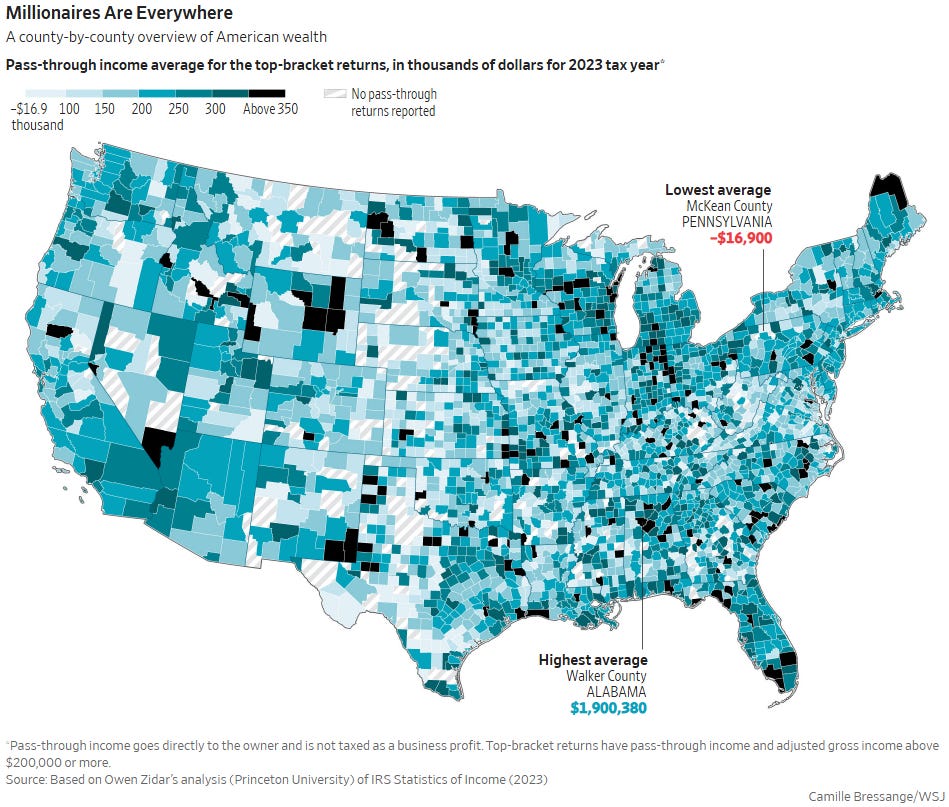
The chart is not saying how many millionaires each county has or average household income or anything like that. It’s an average of pass-through income for folks in the highest tax bracket. This means that folks who are in the highest tax bracket in each county, how much pass through income are they reporting on their tax forms on average. This is, according to the authors (and logic) a proxy for business owners who make a ton of money (bringing in $350K in a place like Walker County, Alabama is a ton of money).1
The chart makes one clear claim: where are entrepreneur millionaires? Pretty much everywhere, not just concentrated on the coasts or in one place.
The map does not show that the middle of the country is richer or produces more entrepreneurs or anything like that. But it does demonstrate that the road to wealth throughout most of the country still has a lot to do with entrepreneurship.
Of course, this makes perfect logical sense for anyone who lives in the real world. You meet a rich guy, ask what they do for a living, and a large percentage of the time they are an entrepreneur. They built a home services business, or own a bunch of franchises, or started a tech company, or something like that.
There are ways to generate wealth everywhere in the country. It’s not just about the high flying success stories that normally get written up in the WSJ. WSJ has written ~70 articles about OpenAI this year alone (2026).
In fact, the referenced WSJ article goes to great lengths to make the point that these businesses, which are minting millionaires, tend to be ordinary, unsexy, incremental or… boring.
They say things like:
Across America, such business owners—we call them Everywhere Millionaires—have built extraordinary fortunes running ordinary businesses.
and
And increasingly, the opportunity of “unsexy” businesses is drawing elite graduates away from the traditional big-city jobs.
or
Unlike the transformational innovation central to economic growth, the innovations of Everywhere Millionaires are often more incremental. Dick Portillo learned to steam buns by watching someone else do it. From that, he built a billion-dollar hot dog behemoth. His business grew because he sold a product that people wanted.
Maybe that’s true? What makes a boring business, however, is a broader question. The article in question makes the claim, as you see above, that it’s incrementalism. They aren’t reinventing the wheel. There is, for lack of a better term to use in this blog, a playbook that exists, and it’s not a complicated one.
To highlight this point, the authors spend a lot of time profiling Midwest Entrepreneur legend, Dick Portillo, founder of the Chicago-crazy hot dog chain, Portillo’s. Which, okay, fine. Selling hot dogs is unlikely to be a sexy business. It should be pretty straightforward, right? They probably just sold dogs that people liked and then just slowly grew over time?
Sort of.
On further review, there are many twists and turns to this story that are worth studying.
It was a hot dog stand that Dick Portillo opened up after serving in the Marines right out of school. From 1962 - 1967, he turned the stand into an actual going concern and real business. Then from 1967 until the 1990s, the company grew to 25 stores and was doing $50 million in revenue. It was bought by Berkshire Partners in 2014 (at the time they had ~38 stores). Their thesis appeared to have been: this is a great regional brand that has not been expanded nationally. Let’s provide some capital and make that happen. Certainly not the first time that someone had that attitude - there have been many such instances where regional brands were taken national (or international) in a growth effort. Investors love that story.
As Berkshire Partners took Portillo’s on that journey, it went public in 2021. Today it has since expanded to 109 restaurants across 11 states (wow, only 39 more states to go). Interestingly enough, it does not franchise at all, and owns 100% of its stores. So expansion requires real capital commitments.
When Portillo’s sold the company in 2014, quickly after, the founder, Dick Portillo, stepped down as CEO (in 2015). He stayed on as an advisor until a couple of months before the IPO. He has since had no formal relationship with the business beyond public market ownership, if any.
If it were a boring business, that wouldn’t matter. You could find anybody with an MBA and some experience in the restaurant business and they could run this effectively. Again, how many times has a regional chain been expanded nationally? Surely the playbook is pretty basic.
Instead, that’s not what happened. Its post-IPO performance has had the tar kicked out of it in the public markets.
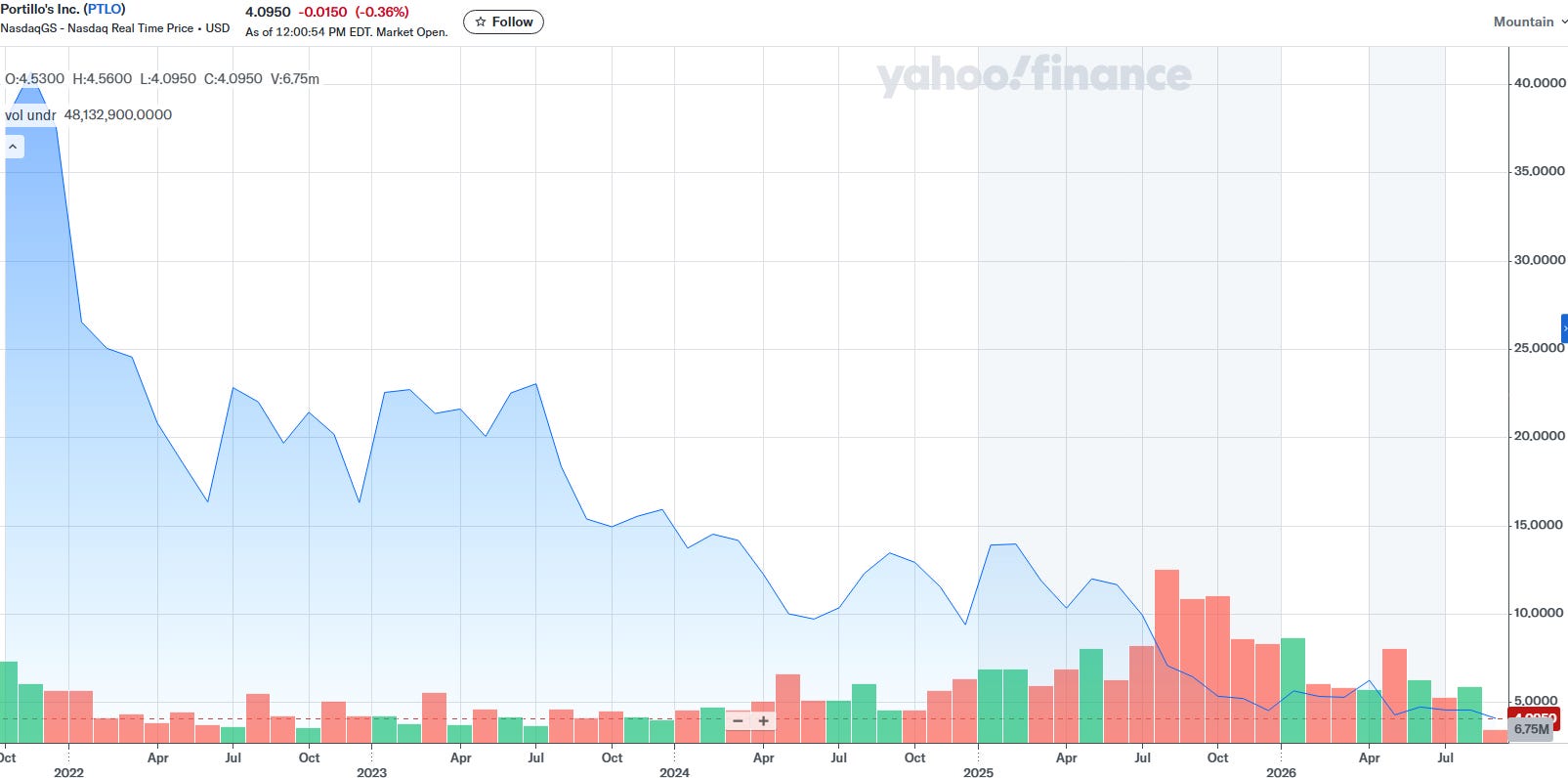
So maybe the business just sucks?
Very unlikely. If you talk to a Chicagoan, you will hear from them how much they associate Portillo’s with their Chicago identity. It is the standard-bearer for the weird way that the region eats hot dogs (who am I to judge, as a Cincinnati-style coney enthusiast?).

Portillo’s does an estimated $8M in revenue per store per year. That is UNHEARD OF in the QSR restaurant business. It sounds like there are a lot of reasons for that enormous stat, but it is unlikely an accident. The Company, over the years, has made deliberate decisions that drives incredible volume through each store, exactly what you want at a restaurant chain like this.
Unfortunately, as of late, that number has shrank. From what I can tell, that has been somewhat correlated to it’s rapid expansion.
You would think that the people who should understand why that $8M figure is so large - what are the key drivers for that figure - would be the ones in the company, actively running it day-to-day. And as a result, they would focus on growing that figure.
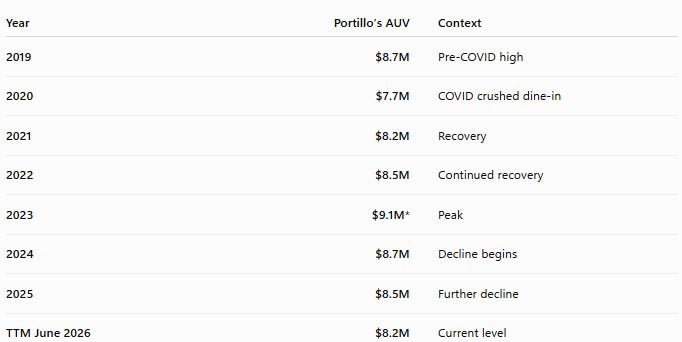
The rapid expansion of the business, mostly beyond the Illinois borders, has been a difficult thing for them to pull off. They have tried to break into Texas without much effect. It’s a very regional-specific food experience. Bringing it to a new region requires a ton of education. Again, folks have done this in the past. But it’s very hard to pull off. And there is nothing boring about the strategy involved.
If you can do it well - fabulous wealth and riches. If not, maybe a ~75% decline in share price from all-time-highs.
Expansion went well when Dick Portillo was running the business. But that’s a founder - there is plenty of evidence that founder-led companies just perform at a different level. And that almost no business on the planet “runs itself”, despite what Jon Rothstein would have you believe.
And, what’s more, studying the successes and failures of these companies is increasingly more important. We have an abundance of data out there on what is going on with companies, both public and private. But actually understanding the strategy inherent in the decisions made and execution done within those companies is a challenge. Publications like the WSJ don’t think they are worth studying. But there is almost always something to learn.
Now, this is unlikely the end-state of the Portillo’s story. There is currently a turnaround effort within the company.
Does that sound familiar?
It’s a big, zero-franchise specialty restaurant that at one point had a strong regional presence and has faltered on occasion when trying to expand into some new, foreign markets. As a result, it’s in the middle of a turnaround process.
You might think of Starbucks, reading that paragraph out of context.
If you follow financial news at all, you are probably familiar with Brian Niccol, new CEO at Starbucks and purported restaurant turnaround king (previously coming from Chipotle). There has been plenty of press about this guy - and a lot of people studying every move that he makes.

But you almost certainly don’t know Brett Patterson, the new CEO of Portillo’s. He, unfortunately, did not go to school in Southwest Ohio, like Brian Niccol, but he has a list of experiences that reads like a strip mall in Fairborn, Ohio:
Prior to joining Portillo’s, Patterson served as CEO of Miller’s Ale House, a brand owned by Roark Capital. He also previously served as Executive Vice President with Bloomin Brands and president of Outback Steakhouse, and held leadership roles with Carrabba’s Italian Grill, Steak and Ale, Bahama Breeze, and Ruby Tuesday.

Today, Starbucks is worth $114 billion, give or take. Portillo’s is worth $300M. Starbucks, in the last two years, has had ~35 WSJ articles written about them. Portillo’s has 1. Yes, Starbucks is obviously worth more, employs far more people, and has more of a national mindshare in general, but they do have a lot of the same existential questions.
To be clear, I don’t think the WSJ should be covering Portillo’s in much more depth than they already are. BUT, if you are a business owner, or making strategic business decisions, and you are running a region restaurant, wouldn’t you want to pay more attention to Portillo’s than Starbucks?
That’s the thing about calling a company like Portillo’s “ordinary”. According to who? Running companies is hard work. You want to learn from your peers. There is nothing ordinary about that.
But also the best investment opportunities do tend to lie where no one else is paying attention. And - TO BE VERY CLEAR - I am not writing this to convince anyone to invest in Portillo’s - that might be a terrible bet for all I know. BUT, I think the basic concept holds, which is that under-covered opportunities, like those here in the Midwest, are where the real opportunity lies.
The punchline is that the darker colored counties are examples where those who are in the top tax bracket are more likely to be entrepreneurs. It’s a slight stretch to make that argument, but if you think about the type of business who has pass-through income for it’s owners, they are typically founder led entities - like LLCs, partnerships, etc.