


Disclaimer: Newsletter and the information contained herein is not intended to be a source of advice or credit analysis with respect to the material presented, and the information and/or documents contained in this website do not constitute investment advice. Opinions contained within this letter are my own and not those of my employer.
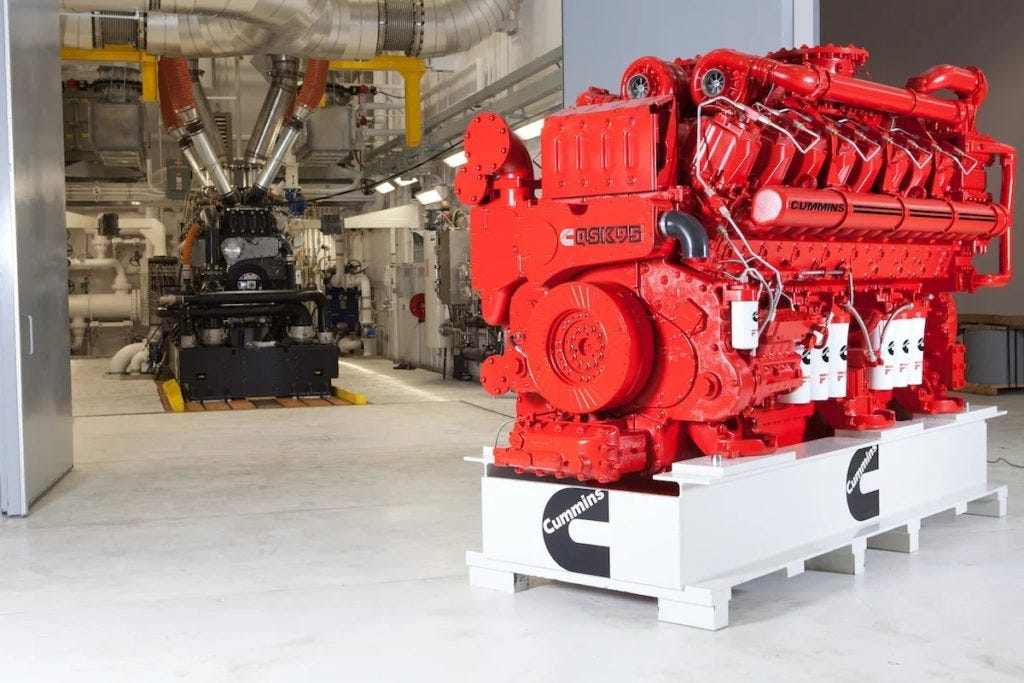
Have you ever been to Columbus, Indiana? There’s a good chance you haven’t. It’s a small town in the Midwest with ~50K residents (20th largest city in the state). It does have some incredible architecture and is the county seat for Bartholomew County. And it has a $33 billion annual revenue Fortune 500 Company: Cummins, Inc.
I always ask myself how massive companies like Cummins end up in “small towns” like Columbus. The answers all lead me back to a couple of core truths:
Talent is evenly distributed, no matter what anybody will tell you.
Big companies almost always start out as small companies. So being a small town isn’t that strange.
Coming out of nowhere is the point.
There are VCs everywhere, whether they call themselves that or not.
Talent Distribution
The first point is not something I am going to spend a ton of time on. If you don’t believe that, read another blog.
Of course great talent is everywhere and evenly distributed. You might look at the list of great companies started in the last couple of decades and erroneously come to the conclusion that the only talented business builders in the world are from the West Coast. Most of the people who build the great companies of tomorrow might live in Silicon Valley, but they are infrequently from there. Maybe talent is pooling right now in one location, but even that assumption is a suspect one. And it was total hogwash in the early 20th century.
The founder of Cummins, Inc. was born in rural Indiana. He grew up on a farm. Clessie Cummins also wasn’t some product of a local initiative to “prevent brain drain” or anything like that. His formal education didn’t extend past the eighth grade. But he was good with machines. How that happened, it’s impossible to say, but he showed an early aptitude for engines. He built his first steam powered engine when he was 11. During the 19th CENTURY!!!
And it’s not like Columbus, Indiana at the time was experiencing some machinery boomtime. It was a sleepy rural town. Clessie Cummins was this way through sheer dumb luck or sheer force of will or something other than being surrounded by other great machinists and engineers.
Apocryphally, he was the kid other people in his small Indiana town would call when something needed fixing. He built a reputation around being someone who could do something like that. As a relative youngster, he served on a pit crew during the first Indy 500,1 which, at the time, was less of a racing experience and more of an engineering endeavor.
Despite (or because of) his natural talents, he landed the job as the chauffeur for local businessman WG Irwin.2 An s-tier mechanical genius was driving people around for a living. If that doesn’t prove to you that great talent can come from anywhere, then I don’t know what will.
After spending enough time with Cummins, Irwin identified that he was more than just smart, he was an inventive genius. And when Cummins pitched Irwin on starting a diesel engine company in 1919, Irwin was his primary financial backer. It’s not like Irwin had an explicit strategy around finding a leader for a diesel business he was thinking about starting. He just recognized great talent and backed it.
Big Companies Start as Small Companies
Diesel was still a pretty nascent technology, especially in the US. It had been invented roughly two decades prior to Cummins getting started, in Europe by a German man named Rudolf Diesel.
Rudolf was trying to find a way to make a more efficient engine. Steam engines and gasoline engines were extremely inefficient at the time (still are, relatively) and had power constraints. Diesel’s invention was focused on solving those problems. Not so much for improved vehicular purposes - cars were barely a thing in the 1890s - but to power factories, marine vessels, and equipment more readily. The Industrial Age was in full swing and inventors were looking for any edge they could find.
Clessie Cummins found out about the technology way before it swept across the country. Around the same time he was impressing WG Irwin, he was also trying to figure out how to improve engines in general. It’s hard to say if there was any spark of an idea - the Company’s lore doesn’t have some story that I could find that caused him to want to get into Diesel Engines other than he thought they would make better engines. But, he was a builder and tinkerer. And he was around engines enough that he probably had heard about Diesel Engines and what they were up to over in Europe.
Why not bring that to America?
So that’s pretty much how it started, as an idea, and a license agreement with a European diesel engine company to use their technology. Clessie didn’t have some big contract lined up. He went out at got one with Sears, but even that ended up blowing up in his face. He had to start over. He didn’t start this as a JV with one of the truck manufacturers of the time (the thought among the big players was that diesel was a joke - a pipe dream almost literally).
That’s how companies normally start. Clessie Cummins saw an opportunity - a problem with steam and gas powered engines - and chased after it. This was probably a pipe dream, where most folks thought it would be useless toil.
Coming From Nowhere is The Point
And toil Cummins did. It took them more than a decade to get anything off of the ground. It was mostly a company focused on tests and demonstrations. They had some sales, but they were generally one-off. There was no scale. It was constantly under threat of bankruptcy. Heck, it practically did file for bankruptcy a couple of times.
Of course, they eventually had a breakthrough, but didn’t reach real success until well into the 1930s. And even then it took some time for their success to really breakthrough and reach the mainstream.
In retrospect, it seems obvious, and even lucky. Sure, start a diesel engine company right before the boom in American freight trucking. Be well positioned to develop diesel engines for the US Military right before the most robust military buildup in human history during WWII. Capitalize on the American Interstate Highway Act post-war.
Maybe that feels like this was inevitable. That if Clessie Cummins didn’t do it, someone else would have.
Or that this was just pure dumb luck. And all that matters is being in the right place at the right time.
But the right-place right-time thing really gets turned on its head when you have to dig it out of the dirt for 15+ miserable years with not a lot to show for it financially.
Almost nothing about Cummins was inevitable. There was no private equity firm sitting around writing their diesel industry thesis paper. Nobody saw this coming. As previously mentioned, most of the insiders thought diesel technology was a sideshow.
And to be clear, Clessie Cummins was an outsider. Sure he lived in the Midwest, but he had no real ties or weak ties to the dominant Detroit auto-industry or the truck industry or the manufacturing industry. The guy was a mechanic. The most insider-y thing about him was his experiences at the Indy 500 as a pit crew member, but even then, that wasn’t exactly a golden passport. Did he use that to demonstrate the power of diesel - absolutely. Use whatever advantage you can get.
But being an outsider is generally the point. Insiders tend to have trouble seeing the deep flaws in their industry (as all industries have) when they are sitting at the top of that industry.
Almost everywhere I go, cities like Cincinnati have an anchor industry that folks want to connect their startups into more directly. And it is very rarely pulled off. Yes, I think there is a right way to do it (someone please start a CPG-focused early stage venture fund in Cincinnati, I am begging you) - but it’s very difficult.
In the 1920s and 1930s, when Henry Ford had already made himself the auto-insider, the folks in Detroit who had already gained a massive advantage in the auto industry didn’t get what was so interesting about diesel engines.3 It gave Cummins a window of opportunity. In fact, it gave him a huge window of opportunity - nearly two decades.
Diesel engines were efficient, but they were loud, used a different kind of fuel, hard to produce, and hard to maintain. That was true, until an outside - Cummins - made it not true. And by that point it was too late for the insiders to catch up.
VCs Everywhere
The problem with nowhere is that it is a place that infrequently has strong capital presence. Raising money in nowhere is hard.
But that’s just the thing with Cummins. Clessie had great skill and promise. He was able to impress the one guy in town who had the capital - WG Irwin. The guy was a banker, but back then being a banker met something totally different than it does in our post Great Recession regulated banking industry world. He had real money and he was capable of bankrolling companies that seemed promising, both personally and professionally. He wrote checks into Clessie Cummins’ company well before it had real data.
And, more importantly, once Cummins started showing off great data, Irwin kept them afloat to keep down the right path. Cummins didn’t have to be a great storyteller. He was able to show his financial backer real data, which turned into more capital. The story he told was tangible because the data kept backing up his claims.
Just like the VCs of the day, WG Irwin required Cummins show demonstrations of success in order to keep bankrolling the operation. Those included the following:
1924 - Model F is released - first Cummins proprietary and successful engine line, even if it didn’t sell like crazy, it proved that the model was working
1929 - significant step change in the efficiency tests - almost went bankrupt, but WG Irwin kept the lights on when he saw the progress on the machines up to that point
1928 - Launched the Model U - another big step forward for engine capabilities.
1930 - They put a four cylinder diesel engine in a Packard limousine and drove from Indy to New York for the auto show, an 800 mile journey, on $1.38 total costs of fuel. Even adjusted for inflation, that’s insane.
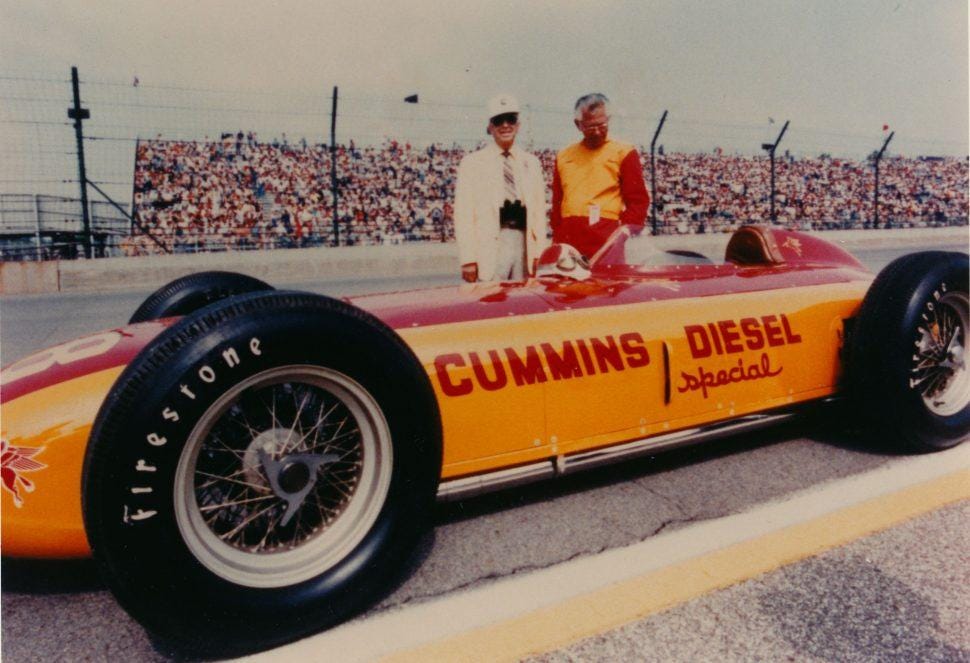
1931 - Entered the Cummins Special into the Indy 500 - first diesel engine in the race ever, and completed all laps, finishing 13th, without a single pit stop.
1931 - Ran a marine boat on river water using their engine.4
1933 - Model H Engine is released. Stop me if you have heard this before, but another step change in the machine’s capabilities.
1937 - FIRST PROFIT TURNED!!!!!!
No, the company didn’t turn a profit right away. It was, obviously, an incredible money losing endeavor. But they kept proving that the product would work and the growth of their capabilities helped them keep their lights on with their “VC” of the era.
VC is not a technical term. The economic function of venture investing predates the modern venture-capital industry. But the core concept of venture - provide equity capital to an entrepreneur to help them get their business off the ground - exists everywhere. That is a motion that has existed forever. Some of the most important companies require years of patient risk capital before the economics become obvious.
I am sure WG Irwin had some money losing endeavors, especially during this time period. But none of that matters, because he bet on the right horse. Just like in venture, the Power Law was his friend. His grandnephew would go on to be the longest-tenured Chairman of the Company and one of the key architects of its post-war success, Irwin Miller. Generational company, very literally.
There are always VCs, whether they call themselves that or not. They are necessary to build a lot of great companies.
For the winning Marmon Wasp race car!!!
During that era, being a chauffeur meant being part-driver, part-mechanic. So it was a different type of job as it is today. But it also wasn’t like he was tapped on the shoulder to run a company from day one.
There actually were diesel interests in Detroit and elsewhere, but they were pretty skeptical of smaller, faster, reliable diesel in trucking. Caterpillar had figured out diesel to an extent, but that was in farm and construction equipment.
Not really what happened… but I am not here to explain how any of these engines work.