


Disclaimer: Newsletter and the information contained herein is not intended to be a source of advice or credit analysis with respect to the material presented, and the information and/or documents contained in this website do not constitute investment advice. Opinions contained within this letter are my own and not those of my employer.
Venture is in a weird place right now. But then again, it’s always in a weird place. It is an industry that is built on the idea of weirdness, and I don’t see that changing any time soon.
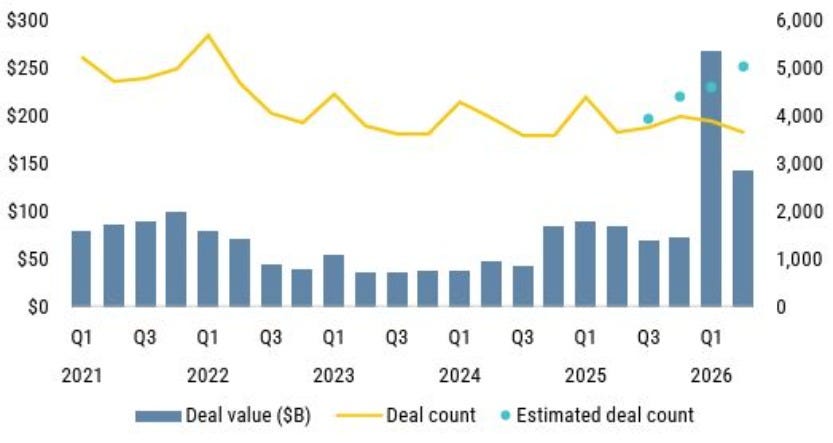
First of all, if you look at the first half of 2026, deal value has gone up significantly, especially in the first quarter. This is almost entirely driven by AI, as you might imagine. Megadeals (rounds north of $100 million) made up 87.5% of the $412 billion deployed year-to-date. Impressively, that exceeds all of 2025 already.
Deal count, on the other hand, is either flat or down, depending on your read of the situation. The massive deals are sucking up all of the air in the room for the more “traditional” venture round. The second quarter saw seven rounds north of $1 billion (there was a time that you didn’t do venture rounds north of $1 billion, you just went public): Anthropic, Prometheus, Anduril, Baseten, MiRus, Kalshi, and Cognition. These rounds accounted for $87.2 billion, more than half of the deal value in that quarter.
Anthropic’s most recent $65 billion round represented 15% of TOTAL deal volume in the first half of the year. That is absolutely bananas. Even within the concentration of the concentration, there is more concentration. I feel like Xzibit.

AI deal value reached a total of $355 billion, 86% of all venture dollars. Sheesh.
So, it’s not all AI Megadeals, but it pretty much is all AI Megadeals.
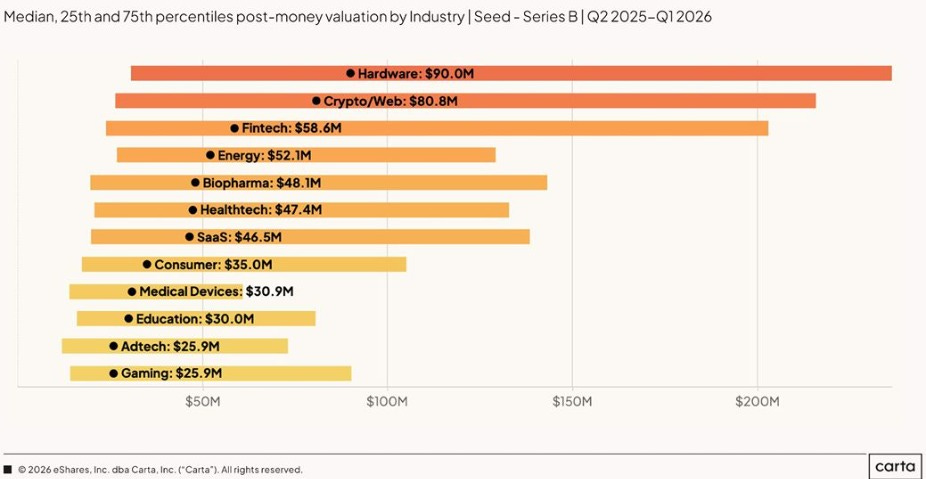
If you go a layer deeper and look at what industries (beyond AI) are being invested in, there is an interesting story to tell as well. Yes, VC mostly cares about AI, but it has shifted everything else it cares about as well. Hardware is now one of the top valued industries in the sector broadly. That is nuts when you consider that several years ago, Hardware was at the bottom of everyone’s valuation stacks.
Likely this is a sign that everyone is scared about the idea that the SaaSpocalypse is coming and that traditional VC-backed industries over the last 15 years are at the highest risk for AI disruption. Hard to say if that is true or not, but AI has massively disrupted the software engineering profession in a lot of strange ways. And this level of uncertainty causes investors to seek safe havens. It’s likely that AI makes SaaS as a category MORE VALUABLE (read:Jevons Paradox), but uncertainty scares investors, who flocked to SaaS specifically because of the certainty of those sweet, sweet enterprise contracts.
Hardware is seen as one of those safe havens because Language Models haven’t really figured out how to disrupt the physical making of things very effectively yet. Barriers to entry like that are much more interesting.
That, or Anduril is the hot, yet attainable, ideal of a venture startup these days. And everyone wants a piece of the defense industry, which mostly deals in hardware. Or maybe the current administration’s technology buying habits have shifted what makes defense tech most compelling, which, again, shows up in hardware data.
It’s hard to say which one of those things is right or wrong, if not all of them. But the other reality is this all pales in comparison to AI. Notably, that’s not listed on that chart because AI is now just assumed to be part of pretty much every industry these days. It would be like having a separate column that says “tech”. No duh.
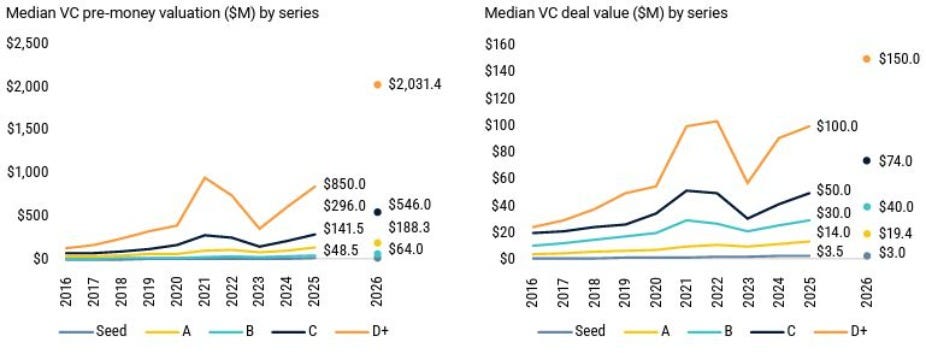
As you might imagine, valuations and size of rounds have gone up for pretty much every round, with one notable exception: Seed.
AI is skewing the data higher for everything, so these numbers don’t tell a full story. But interestingly enough, Seed is basically flat from a valuation perspective. In fact, it’s down on a deal value perspective as well.
It’s really hard to have a Mega Deal Seed round. Try telling everyone you are doing a $100M seed round with a straight face. Some people do this and they get lampooned. So seed rounds in that space get “skipped” altogether. (and not really skipped, but just renamed to Series A).
And again, those Megadeals are not traditional venture plays. They are checks being written by massive funds with exhorbitant expectations. So AI has made venture data look like it’s a euphoric period, but I don’t think that’s right. The massive rounds are skewing everything, meanwhile, the non mega deal stuff is still essentially business as usual, maybe slightly better. Just look at seed rounds, which are rounds you typically can’t fake. They can’t be overtly influenced by crossover funds or megafunds because those types of investors don’t really do seed investing. Seed investors aren’t typically megafunds and vice versa.
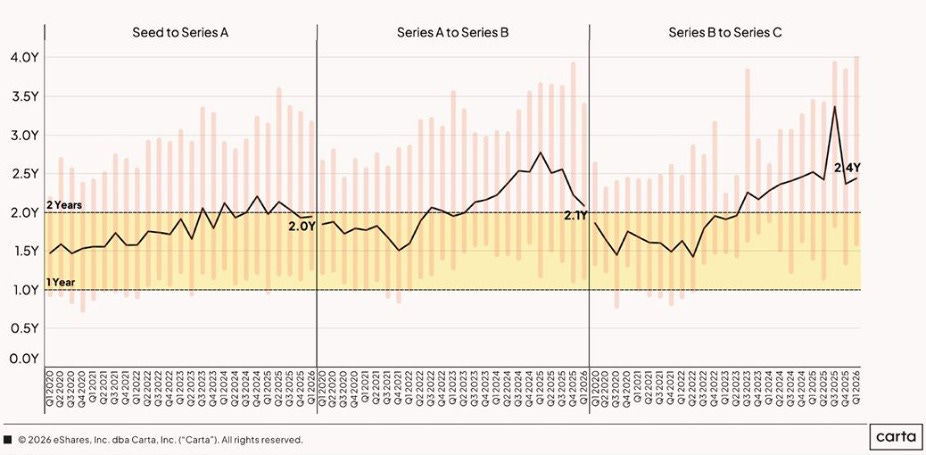
And the data would show that it is getting to be a slightly better fundraising environment. It just takes less time to raise in between rounds, generally a signal that the market is competitive for assets. It’s mostly getting better beyond Series A, however, not so much earlier rounds.
But even this is slightly skewed. What I think is going on here is that top-class assets are having an easier time fundraising, while mid-tier assets are foregoing that experience all together. They did their down-rounds a couple of quarters or years ago and they are focused on being cashflow breakeven and owning their future.
And because these top-class assets are so scarce, the market is more competitive for them, driving up terms, valuations, shortening diligence cycles, etc. etc. That makes it look like a frothy market, but only for a certain subset of companies. And sometimes these subsets of companies turn into Mega Rounds because they are so hotly competed for.
The interesting thing is what makes a “top-class” asset. Sure you could just say it’s AI, but there is more to it than that as well. AI is such a disruptive force that I don’t think anybody knows what top-class really looks like (until revenue data really rolls in; more on that later). As a result, again, Seed is really hard to price, and Series A and B rounds are all over the place. A lot of folks doing Mega Rounds at A and B are taking HUGE swings on what they think the future of the world will look like post-AI.
First, that’s cool. I like people taking risk.
Second, that’s scary. We don’t know what the future is going to look like. We don’t live in a post-AI world. We are in the middle of it right now. A lot is unsettled. Adoption is still crawling along. It’s promising, certainly, but there could be a lot of Webvan moments in the ether.
WHAT ABOUT VENTURE FUNDS
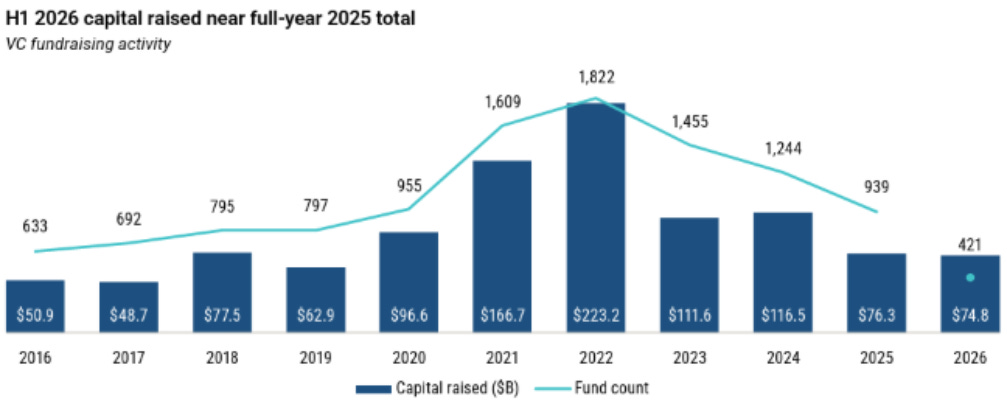
And this wonky, concentrated economy isn’t just for venture-backed companies, but venture funds in general are dealing with a parallel experience as well. It’s not a mirror exactly, but it is similarly distributed.
While the amount of capital raised by VCs hasn’t massively eclipsed 2021 levels like the venture-backed levels have, most of the funds (value and count) being raised are concentrated in one area. A couple of breathtaking stats:
In 2026 YTD (as of June 30), US VC funds raised $74.8 billion across 421 vehicles. That total sits only slightly below 2025’s full-year figure of $76.3 billion, pointing to robust fundraising momentum.
Funds above $1 billion accounted for 68.3% of total capital raised in 2026 YTD—a decade high—up from 36.1% in 2025.
Just 12 firms that closed $1 billion or more in aggregate 2026 commitments accounted for 74.6% of total capital raised. Large managers continue to hold more of the available dry powder, concentrating pricing power even further.
The sub-$50 million fund count peaked at 779 in 2022 and has since fallen to 538 in 2025 and 285 in 2026 YTD.
Overall, VC funds are being raised, but it’s mostly accruing to just a handful of names.
WHAT ABOUT EXITS
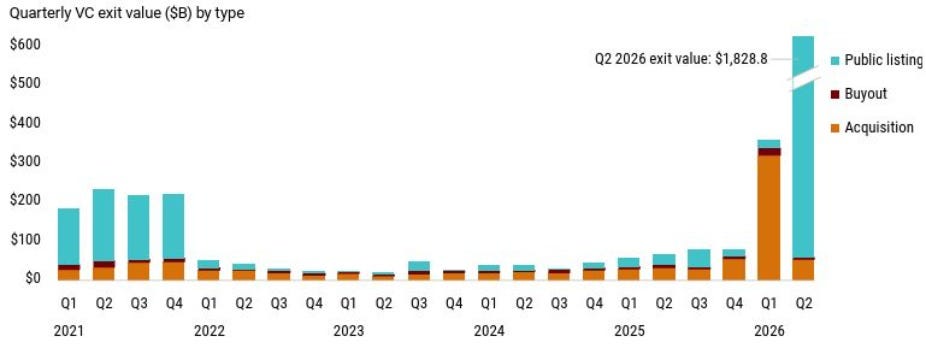
On the face, it looks like, as the kids say, WE ARE SO BACK. Technically, yes, 2026 is a record high year for exits, particularly IPOs.

But, if you remove the one major exit driver from the data, the first half of this year (~$240 billion in exit value)would land relatively in line with historical averages, maybe continuing a slight uptick compared to all-time lows in 2023. The IPO window is cracking open, but the dam has yet to break.
The numbers are skewed by one big outlier (smuggling a couple of other outliers within it). And that is SpaceX.
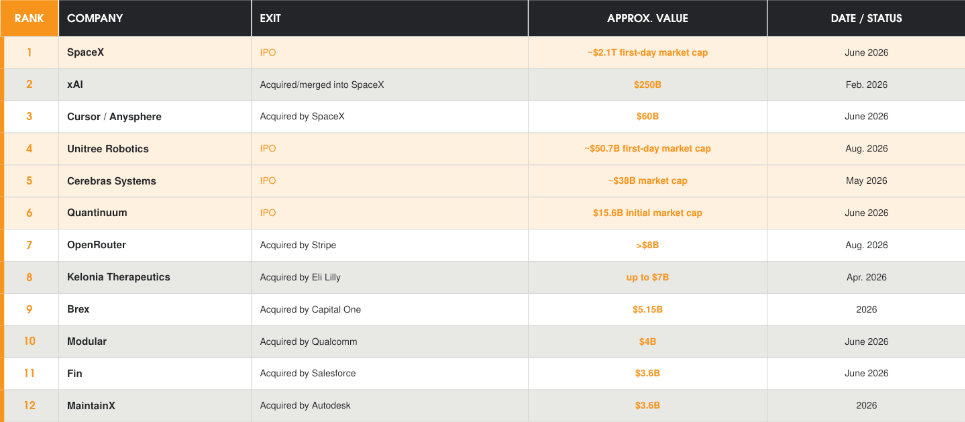
The $1.7 trillion valued IPO earlier this year was the largest US VC-Backed tech IPO of all time, beating the prior all time record holder by 17x. They have also acquired Cursor for $60 billion and merged with xAI for $250 billion in Q1 ahead of the IPO. Those values alone are buoying a ton of the exit market.
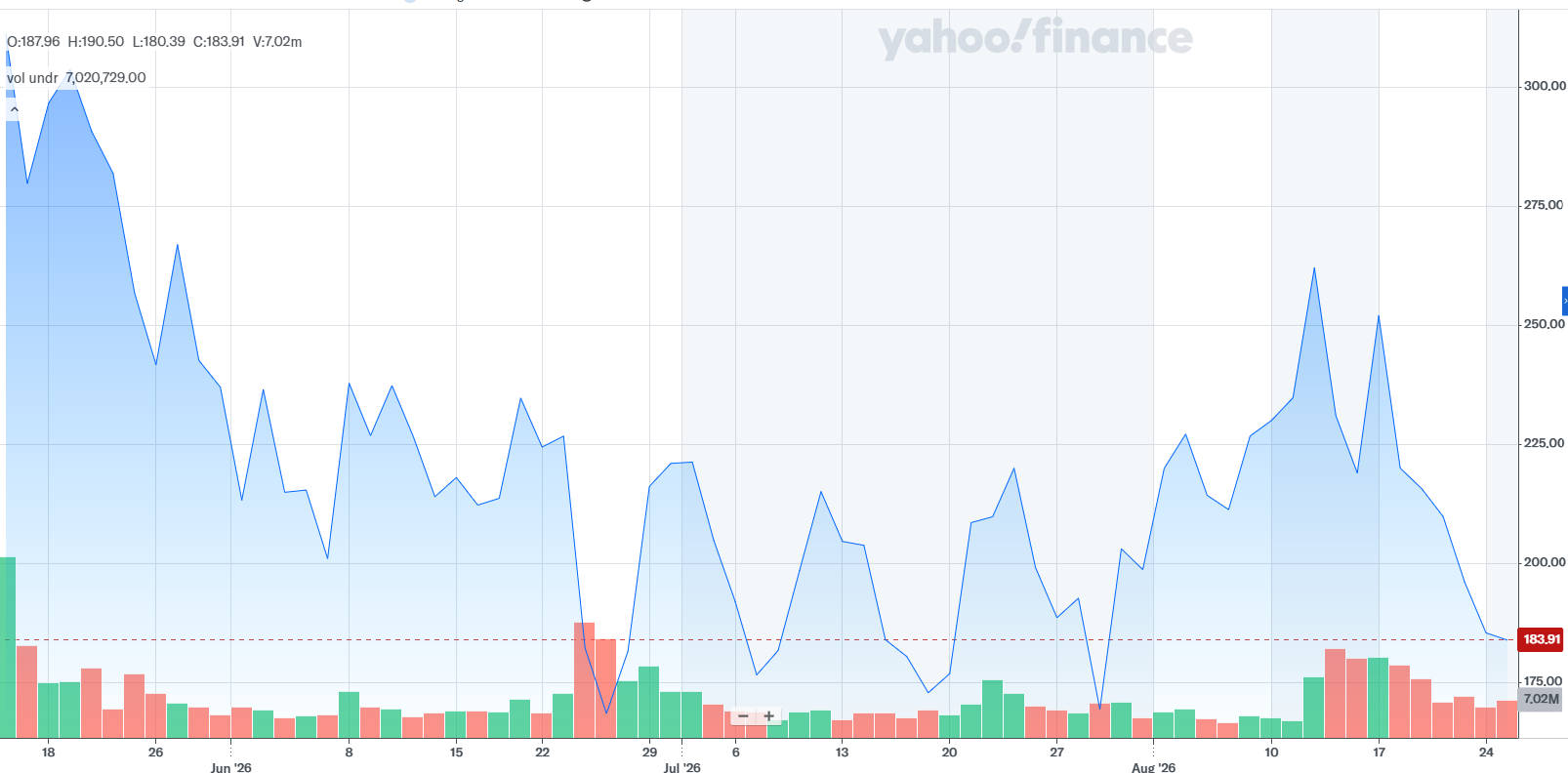
One exit example: Cerebras, positioned as competitors of Nvidia. In 2025, they cancelled a planned IPO, and raised $1 billion instead. Then it completed an IPO this year at 5x it’s prior valuation. Pretty cool, right?
Except, the stock price has been pretty battered this year.
Despite all of this, some companies are exiting.
But there are some case studies on how things are so wonky in the market. A lot of companies had extremely high watermarks during the post-COVID ZIRP era (2021-2022) and are still trying to play catch up with these valuation expectations. This is causing a backlog as their investors figure out what to do.
A great example is Airtable, which just got acquired by Bending Spoons for $2.5 billion in August.
Below is a chart of the exit multiples for the various rounds of capital raised by Airtable.

There are a bunch of folks who didn’t make a ton of money. Anything beyond Series C just returned 1.0x capital, and even several A and B round investors who participated heavily in the later rounds also only returned 1.0x their money.
On a $2.5 billion exit! That’s insane!
$2.5 billion just isn’t enough for some of these funds. A lot of the funds who invested at those levels have funds that are so large, and their checks are so big, that they need exits north of $20 billion or $50 billion. And, frankly, the only way to do that today is…. get acquired by Elon Musk?
That doesn’t make any sense.
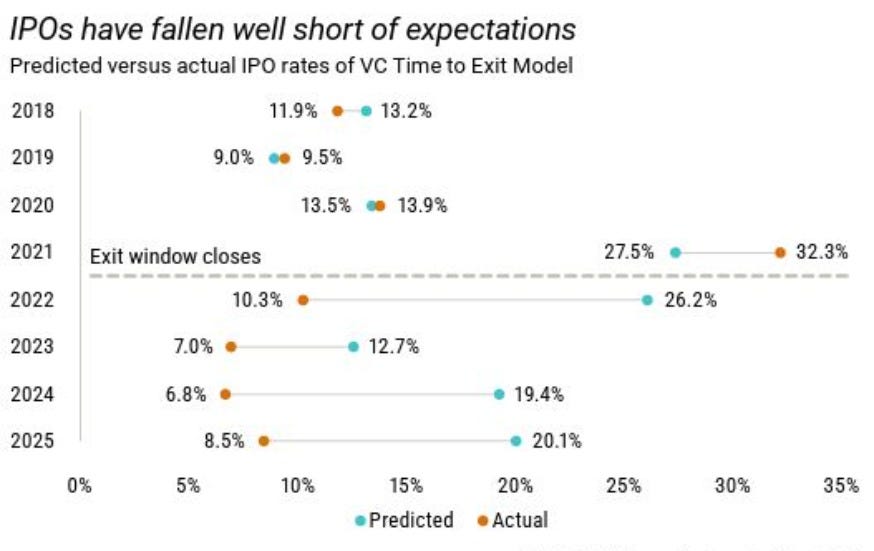
This shines a light that for the past four years, exit expectations have been way higher than exit reality. Part of that was the ridiculous euphoric exit levels that occurred in 2021 rerouted everyone’s expectations. And when those same exit levels didn’t occur in 2022, folks started downshifting expectations in 2023 back to normal levels. The market still didn’t match those expectations. Despite that, expectations went back up again in 2024 and 2025.
The reason here can be summed up in one statistic: in Q2 2026, active unicorn counts reached a record 945, up 9.4% from year-end 2025, and aggregate unicorn value totaled $5.3 trillion.
There is a unicorn backlog. Folks keep expecting them to go public, but it’s not happening.
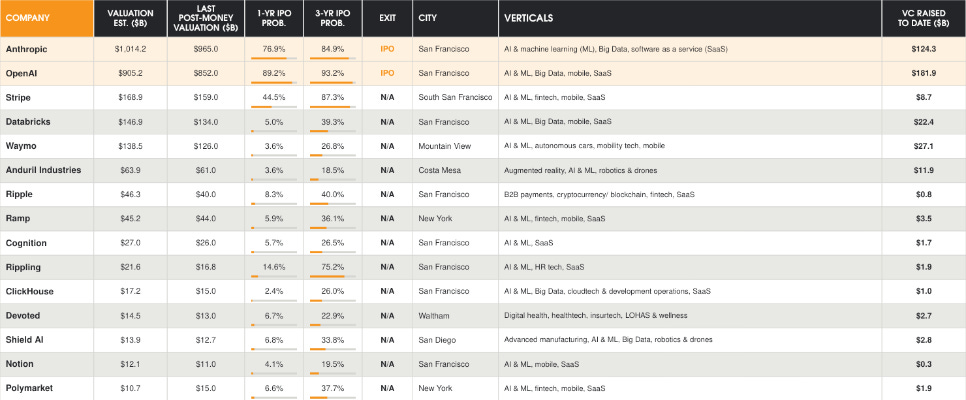
So we have a lot of unicorns, but why aren’t they going public? The chart above is representative of some high-profile examples. Most have survived post-ZIRP era write-downs, shifts in expectations, etc. and now have solid growth curves and good balance sheets (relatively). In theory, they should be prime IPO candidates.
And interestingly, the ones who I would consider to be non-ZIRP era companies, like Anthropic and OpenAI, appear most poised for public listing.
Why are the rest staying on the sidelines?
Overall, the macro isn’t very good - the IPO window is very wonky, public markets are very wonky, seeing the few folks who do go public get beat up is making folks scared, and overall, the broader market is still waiting for the dust to settle on AI expectations. What is good today from a growth perspective? When new things happen in a marketplace, that means old things are very hard to find comparable valuations for.
Funds raised are too high - need crazy high exits. A $2.5 billion exit for the mega funds frequently just doesn’t cut it.
Valuation catch ups - some are still overvalued from 2021 highs, despite 5 years of catch up.
But the flip side is that there are some companies who are fueling NEW extreme expectations:
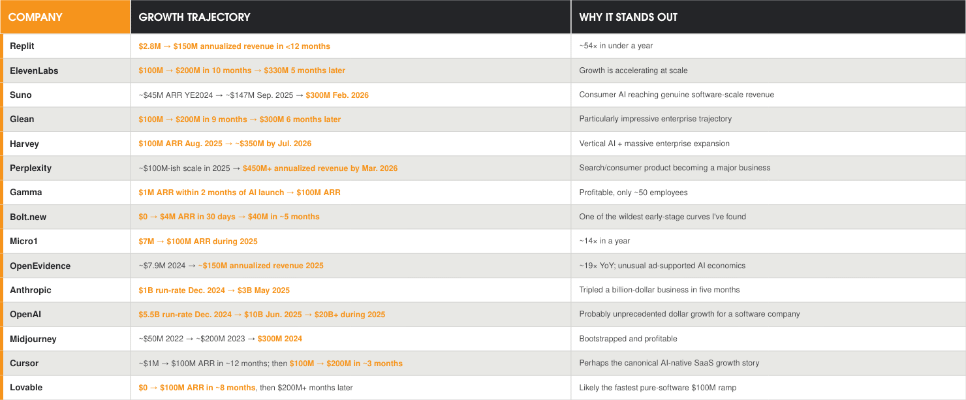
If you go through those growth numbers, they are eyewatering. There are some who thinking that going from $1M to $100M of ARR in 24 months is what is expected from venture-backed startups these days.
And it’s hard to blame those folks. There are a big pile of examples over the last couple of years that are high profile enough to grab everyone’s attention.
It’s hard to know how sustainable that really is. Is that a new normal or an abberation in the marketplace because of AI spend pullforward? Most of the data that has been provided is devoid of context - who are the customers, do they have customer concentration, what are the margins, what is their burn multiple, what does their churn look like, etc. etc.
An alternative way of looking at it is that OpenAI, who two years ago was considered the undoubted leader and winner in AI is now being lapped by Anthropic from a growth perspective. What’s nuts is that, reportedly, OpenAI has grown from $20 billion at the start of 2026 to $40 billion in run rate revenue so far this year. Unfortunately, adding $20 billion in revenue in 8 months just doesn’t cut it anymore because Anthropic has reportedly gone from $10 billion to $50 billion in that same time period.
That’s absolutely bonkers.
And it’s really hard to say that is sustainable. In order for them to grow into their valuation, they need revenues that subsume the entire GDP output of our country. There are people at Anthropic who believe that to be possible. But that’s one of those things that is such an intense projection that it’s hard to take at face value (until disproven).
What this means for the Midwest?
Our region here gets very little venture capital dollars and deal flow compared to the rest of the country at 4% in the Midwest, compared to 18% in the Northeast, 20% in the South, and 58% in the West. A measly 4%, compared to our 20% of GDP output and 20% of the population.
Longtime followers of this newsletter/blog know that this is a cause for concern because venture could be viewed as a (very rough) proxy for innovation. And regions without innovation tend to die - sometimes quickly and sometimes very slowly, but painfully.
In my opinion, solving this mismatch of economic activity versus venture activity is one of the key existential crises faced by our region (and, as a result, our country as a whole - America is nothing if our core gets hollowed out). I have dedicated my professional career to figuring that out and filling that gap.
The euphoric valuations the venture industry is experiencing today are mostly flowing into AI companies based in the Bay Area. Some companies in Southern California. Some in Texas or New York. But practically none here (some examples, like Skild AI in Pittsburgh… but is Pittsburgh Midwest??).
A question might arise of whether or not this capital race is worth it. Is pouring money into AI a useful exercise.
What will these AI companies do, exactly, to our economy and our society and our way of life? Kill God? Replace 50% of white collar workers? Create a more flexible and elastic labor supply? Radically change the way work is done? Make software engineers better at their jobs? Replace Google as the primary way of finding information on the internet?
I don’t really know what the final outcome of the AI race will be. Probably because there wont’ be a “final outcome”, not any time soon. The long arc of technology progress is exactly that - an arc. When there are races, there tends to be froth in the market. And froth begets bubbles.
Participating in bubbles is frequently something that is BAD, but structurally NECESSARY for innovation. The dot com bubble was bad for participants, but it built the infrastructure we needed to bring internet into homes throughout our country (despite what you think of the internet, the modern Gutenberg Press will be viewed as a positive on society, let alone the economy). The aviation bubble in the 20s created viable commercial flight. The electricity bubble in the late 19th century brought electric light into everyone’s homes. The various 19th century railroad bubbles connected our country.
You get the point.
But to be sure, these bubbles were all painful.
I do think AI matters and it is important. I think it will change how we live. I don’t think we understand what that means, exactly (no duh).
And right now, the Midwest isn’t really participating in this bubble. Like the rest of the nation, we are caught in the middle of a data center infrastructure build out, and this is impacting local businesses across several vectors, but most of that appears to be temporary, not systemic for the local economies. TBD on how long that holds, however.
So the froth is hardly in places like Ohio, Kentucky, Michigan, etc. But our economy is deeply connected across the country. Just because we don’t participate in the upside doesn’t mean we avoid the downside.
However, the reality is that great innovation almost always occurs in places where others aren’t looking. And right now, that is the Midwest. Even EUROPE has top class AI Labs. But Chicago doesn’t.
If this is where the hype is not occurring, that gives us the license to build things outside of the hype cycle. Of course, even that can be hard to do, but it is where the opportunity lies. We didn’t really find a way to take advantage of that during the last massive technology bubble, but I personally believe we have a more equipped technical talent base to pull that off now versus 26 years ago.
Time and again, data has proven out that it is within the auspicious of earlier stage rounds, smaller round, less-consensus rounds, that is where venture returns occur. Just look at the Airtable example up above. Those early folks made a ton of money, even if the cap table got completely jacked-up.
Where others aren’t looking is where the really opportunity exists. Right now, the world of venture has taken it’s eyes off of the Midwest.
Great - challenge accepted.
**shoutout to Pitchbook and Carta for a lot of these charts.