


Disclaimer: Newsletter and the information contained herein is not intended to be a source of advice or credit analysis with respect to the material presented, and the information and/or documents contained in this website do not constitute investment advice. Opinions contained within this letter are my own and not those of my employer.
Of Hamilton Helmer’s 7 Powers, the one that tends to elude me the most is Branding. Of course, I understand Brand as a concept - you want something because of who makes it or who is marketing it, not necessarily because of the inherent qualities of the product or the value the product / service generates for the buyer. But where I can get a little lost is around the idea that A LOT of brands are well thought of because they inherently imply quality and THAT is what someone is paying for. So are you buying because of the brand or because of the quality?
If it’s for quality, wouldn’t that imply some other form of power, like Process Power?

There are, of course, tests to feel out these kinds of questions. The best one for Branding Power is whether you would buy a completely equal product and pay more for it (critical!) simply because the branding is different. A Tiffany’s item garners a better price simply because it’s Tiffany’s, as opposed to a similar piece of jewelry. But… are there really similar pieces of jewelry? Doesn’t that idea fundamentally misunderstand jewelry, which are viewed more akin to a piece of art, which means that true similarity is hard to come by?
Much like intangible assets on a balance sheet, Branding is a trickier power than most give it credit for. It’s full of paradoxes.
Ultimately the market will bear this out. Part of why any it’s worth studying Helmer’s 7 Powers is that these powers theoretically give companies an edge in enterprise value. They demand a higher price. Frequently, Branding Power occurs when a price premium is paid for an asset that doesn’t have another discernible power - otherwise, why would that premium be garnered?
An excellent example is the modern NFL franchise. The price tags for these things are absurd, and the valuation multiples don’t make financial sense from a cash flow perspective. These assets just don’t generate enough cash (on their own) to be valued what they are valued.
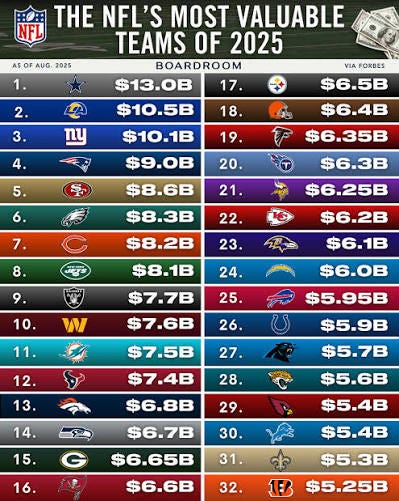
But who wouldn’t want to own an NFL team? I mean, if I owned the Bengals I would probably become the most hated person in Cincinnati. And I would probably still do it.
Sports are cool. Americans in particular love sport and love football. And who doesn’t want to be cool?
Since all NFL teams are worth a lot, doesn’t that dilute the brand power? No, the brand power lies in the NFL broadly, and is distributed, unevenly, but still ratably, to the various teams. The NFL has branding power, which trickles down to the rest of the league.
And I don’t think it stops there. There seems to be a certain premium paid for any sporting assets. Again, sports are cool. And the pro teams are a legalized pseudo-monopoly. So their service providers, financial partners, and goods manufacturers have an incredibly unique place in the market.
And the Midwest is an even more sports-crazed part of the country, depending on the sport. Nobody cares about basketball like Indiana, nobody cares about football like Ohio (will not hear it about Texas and Florida), and nobody cares about hockey like Minnesota. And very few care about baseball like those maniacs in St Louis.
“The worst best fans in baseball”
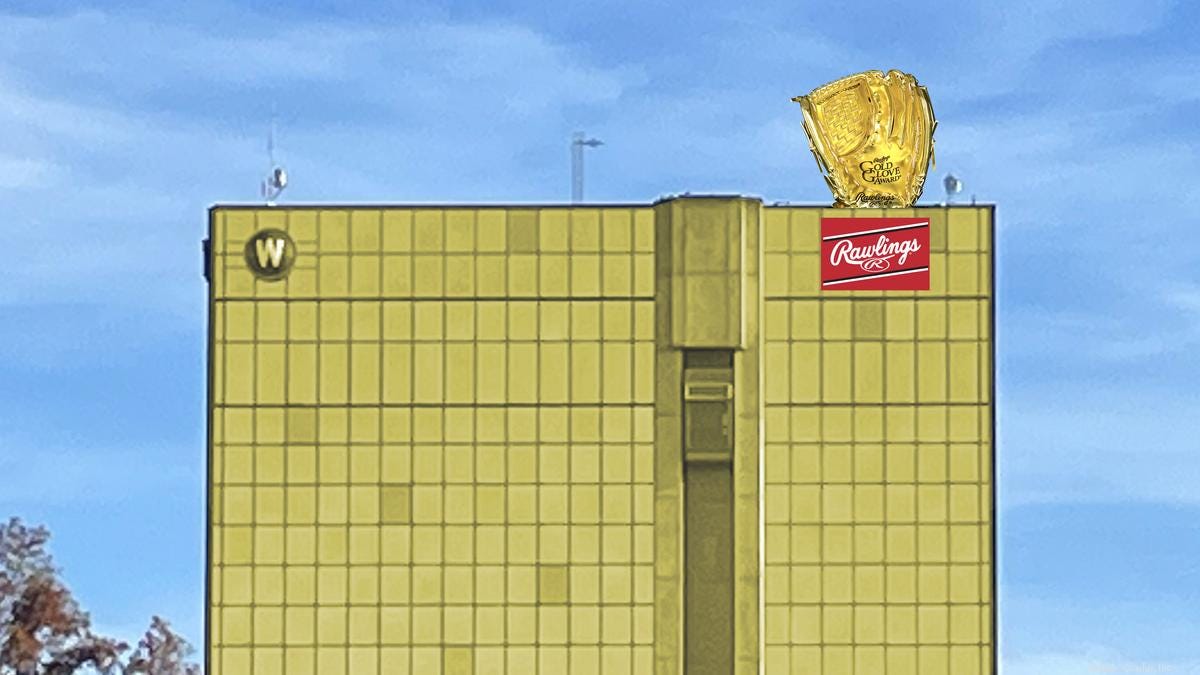
So it’s not really a surprise that one of the crown jewels of the baseball industry is located in St Louis (yes, St Louis is Midwestern). Rawlings has been around since 1887 (five years after the Cardinals got their start and almost TWO DECADES after the Redlegs got their start). It was a general purpose sporting goods store for a while. But as quickly at 1906, it started supplying baseball gloves to the Cardinals.
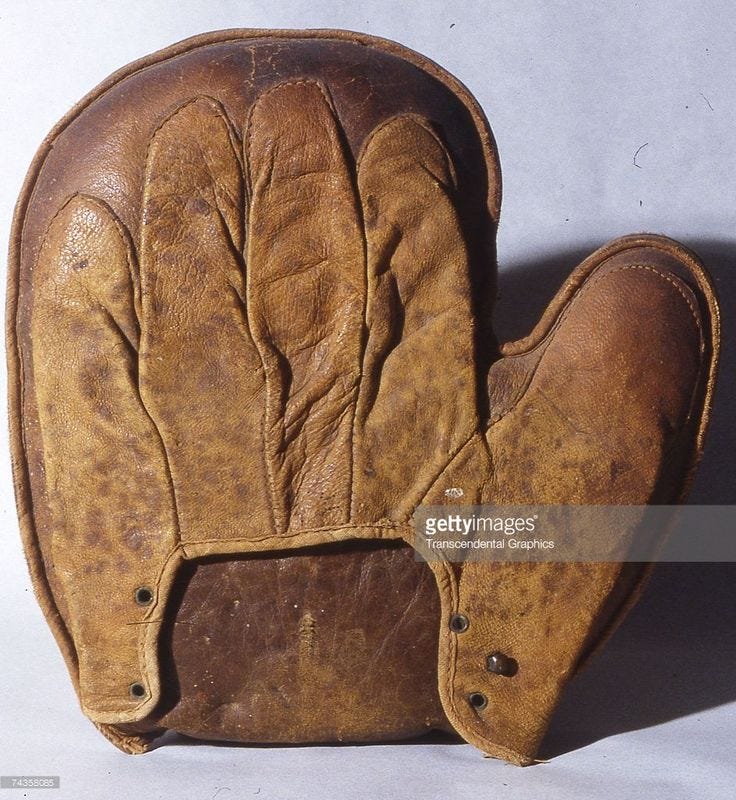
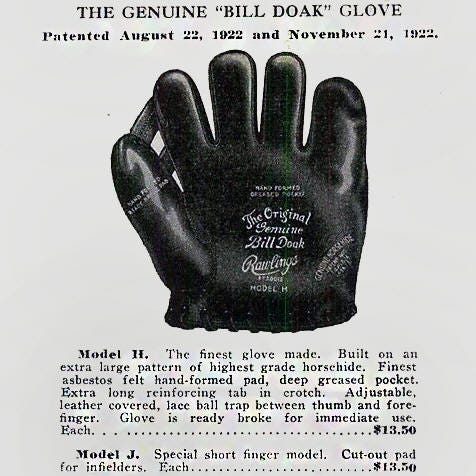
The Company’s big breakthrough was the Bill Doak glove, shown below. This added webbing between the thumb and first finger to create a pocket. It changed baseball, probably. I don’t really know. But it’s their claim to fame. Doak patented the glove design and sold it to Rawlings.
This allowed them to be a key player in the sport across the country, not just for the Cardinals. It was a superior glove at the time. It gave them the cache to do things like create the Gold Glove Award and become the official baseball of the MLB (1977 - present).
The corporate ownership history is sordid and all over the place, however. By 1955 they were acquired by Spalding. They spun out as a public company in 1994. Then they were taken private by sports conglomerate K2, which was then acquired by Jarden (not even a sports conglomerate, just a regular old conglomerate conglomerate) in 2007, who was then acquired by Newell Brands in 2016 (for $15 billion in cash!).
Then, in 2018, it sold 75% of the business to Seidler Equity Partners and 25% to Major League Baseball. For the first time in ~20 years, it became a standalone business. The price tag was $395 million.
Seidler Equity Partners is not your normal PE shop either. It is run by Bob Seidler, whose family (his late brother Peter) used to own the San Diego Padres baseball team. They are in the process of selling the Padres this year (2026 - Peter passed away in 2023) for a reported $3.9 billion. Beyond the 25% stake owned by MLB which acts as an incredible distribution mechanism, Rawlings ownership used to directly have the ear of every owner within the MLB, whose baseball influence extend far beyond the pro game. But now that they sold the Padres, the Seidler family isn’t really in the baseball business anymore, other than Rawlings. And so their purported exit from the company starts to make a lot of sense.
On top of this, the MLB reportedly sold some secondary of their stake in the business (along with sports-specific PE shop, Elysian Park Ventures) in April of 2025. There really aren’t a ton of details around that sale either - how much, both price and amount are unreported. So it’s hard to know what exactly that means or if they were just looking for some liquidity.
Like most PE shops, Seidler Equity Partners advertise how the have “a long term approach”, “act like a family office”, want to “preserve founder culture”, act like “patient ownership”, etc. etc. I am not saying that they don’t do those things, just that most PE shops would have you believe that they do - it’s very common PE marketing. They do have a track record for keeping founders onboard after they get acquired, which is somewhat rare in the business. They also have a handful of companies that they have held well beyond the normal PE 4-7 year deal lifecycle.
Now it is being rumored that Seidler is putting Rawlings on the market for $2 billion.
To be extremely clear about something: that does not mean it has successfully sold. Nor does it mean it is necessarily worth $2 billion or will get a $2 billion price tag. Remember that price is what you pay and value is what you get. But the current ownership group of Rawlings believes that it is worth $2 billion, if the reports are to be believed (pretty reputable sources). And they likely don’t need to sell the company, but are interested in getting out of the baseball game altogether. In other words, there is a desire to sell, but no real known urgency to sell. Critical when it comes to pricing theory.
So the question becomes how does a company like Rawlings become worth $2 billion? That’s a pretty good step up in a ~6 year period from $395 million in 2018 to $2 billion (~5.0x, which would assume a ~22% IRR). That’s a good return.
It’s a private company, so we don’t have great insights into their financials. But the company reportedly did $330 million right before its sale in 2018. Assuming (MY ASSUMPTION, TOTAL BALLPARK ESTIMATE, PUN INTENDED) a 20-30% EBITDA margin ($66M - $99M of EBITDA), this would mean the company got sold for a multiple range of 4.0x - 6.0x, which is somewhat discounted compared to other consumer brand business in the 2010s.
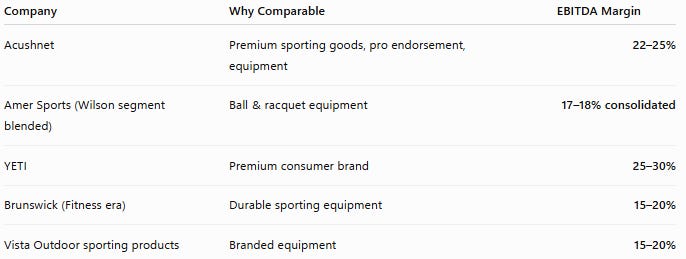
So, let’s just say that the same multiple range applies here (no multiple arbitrage), then the EBITDA to reach $2 billion in valuation would have to have grown proportionally with EV. That means likely EBITDA would have to reach $333 million or up to $500 million.
Where could that come from?
That would be remarkable growth in that time period. Baseball hasn’t not exactly grown from a participation perspective in line with 5x EBITDA growth. Of course, there could also be margin expansion that is occurring as well, but I find that somewhat hard to believe for a company manufacturing sporting equipment - sure there could be some improvement, but 10-20%? Where would that come from?
For a public comp, we could look at Amer Sports, which makes Wilson, Louisville Slugger, Arc’teryx, among others. Wilson makes baseball gloves which are directly competitive with Rawlings, so it’s a decent comp.
Amer grew from $3.07 billion revenue and $394 million EBITDA in 2018 to $6.57 billion revenue and $1.15 billion EBITDA in 2025. That’s really good growth, but not 5x, obviously. And if you look at their growth vectors, most of it came from Arc’teryx, who is growing ~30% annually. Wilson, on the other hand, had not as material growth over that period. 2025 was a year of “rebound” growth, meaning it had been sliding previously.
Margins did expand dramatically for Amer, from 12.8% to 17.5% from 2021 to 2025. This was largely driven by expansion into DTC, which drives better margins, and growth from higher margin brands in general, like Arc’teryx.
All of this is to say, it’s unlikely that Revenue and EBITDA growth are purely the reason for the growth in valuation for the business. Other comps, even ones growing rapidly, didn’t experience that level of growth.
But, the good news is that operational growth is not the only way to expand valuation.
Looking back at Amer Sports, the company was purchased for approximately $5.19 billion in 2019 (a year after Rawlings’ acquisition), at an implied 11-12x EBITDA multiple. Way above the Rawlings number!
And since then, Amer Sports has gone public, currently trading at a ~19-20x EBITDA multiple today. That is about equal to the implied EBITDA multiple for Rawlings would be even if they stayed flat from a growth perspective since 2018. 20x EBITDA of ~$99 million is… $2 billion.
It’s likely that Amer Sports is getting some premium because of their growth categories like Arc’teryx and just generally being a public company, so it’s hard to believe that Rawlings would gain the same multiple. But I also find it hard to believe that they have stayed relatively flat over the past six years. Let’s say they have doubled in that time frame (completely plausible, considering the interest in consumer goods post COVID), then the implied EBITDA multiple range of 10-12x is pretty reasonable.
But even still, this is a company that effectively has a monopoly on pro-baseball, and is an iconic American brand. A buyer is likely not purely buying it for its financial profile. They are also paying to be associated with that brand, similarly to what the Seidlers likely did.
Ultimately, it’s surprising that the company that effectively dominates the professional baseball equipment ecosystem through its exclusive MLB baseball contract, widespread glove adoption, and decades-long brand position... doesn’t garner a higher price tag than some of its peers. But then again, the seller of the asset no longer has an active interest in baseball, so maybe they feel that their right-to-win in this industry is waning and that there is a better steward of the business beyond them.
Either way, it’s an important moment for an iconic Midwestern Company.
Midwest Deal Roundup
This is a section on some of the most interesting deals (not just venture) done in the Midwest in the last ~week.
🏗️ MasTec acquires The Superior Group for $1.65B
📍 Columbus, Ohio
What they do: Superior Group provides electrical construction, engineering, modular manufacturing, structured cabling, and integrated building systems for commercial and industrial customers.
The deal: MasTec (NYSE: MTZ) acquired the company for an estimated $1.65 billion, expanding its capabilities in electrical systems, integrated building systems, and ongoing facility services.
🩺 Medtronic acquires SPR Therapeutics for $650M
📍 Cleveland, Ohio
What they do: SPR Therapeutics develops a peripheral nerve stimulation platform that provides a non-opioid, minimally invasive treatment for acute and chronic pain.
The deal: Medtronic (NYSE: MDT) acquired the company for $650 million.
🏦 Parkway Bank raises $379M growth capital
📍 Harwood Heights, Illinois
What they do: Parkway Bank provides commercial and consumer banking, lending, treasury management, and wealth management services.
The deal: The bank raised $379.4 million in development capital from undisclosed investors. Approximately $40.5 million was initially structured as convertible debt before converting to equity.
🏦 First Financial Bank to acquire Finward Bancorp for $208M
📍 Munster, Indiana
What they do: Finward Bancorp is a bank holding company providing commercial and consumer banking, lending, wealth management, and related financial services throughout Northwest Indiana and the Chicagoland region.
The deal: First Financial Bank (NASDAQ: FFBC) reached a definitive agreement to acquire the company for approximately $208 million, expanding its presence in the Chicago metro area.
♻️ Sortera Technologies raises $87M Series C
📍 Markle, Indiana
What they do: Sortera uses AI, sensors, and advanced sorting technology to recover and recycle metal alloys from end-of-life products, creating high-quality recycled feedstock for manufacturers.
The deal: The company raised $87 million through a combination of $62 million in Series C equity led by VXI Capital Management and $25 million of debt financing led by Trinity Capital.
🍔 Red Robin sells 69-property real estate portfolio for $62.5M
📍 Portfolio primarily across the United States
What they do: The transaction involves a portfolio of 69 Red Robin restaurant properties across multiple states.
The deal: Op Burgers agreed to acquire the portfolio for $62.5 million, with proceeds helping Red Robin reduce debt and support its turnaround strategy.
🧪 ClarosTech raises $46.9M
📍 Minneapolis, Minnesota
What they do: ClarosTech develops advanced materials designed to enable a more sustainable circular economy through improved resource recovery and reuse.
The deal: The company raised $46.9 million in venture financing from undisclosed investors.
🔐 Empirical Security raises $25M Series A
📍 Chicago, Illinois
What they do: Empirical Security develops AI-powered cybersecurity software that predicts and prioritizes software vulnerabilities using both global threat intelligence and organization-specific data.
The deal: The company raised $25 million in Series A financing led by Brightmind Partners, with participation from Costanoa Ventures, HPA Holdings, and others.
🪟 NxLite raises $13.1M
📍 Canton, Michigan
What they do: NxLite manufactures energy-control coatings for glass and transparent materials that improve thermal performance and reduce energy consumption.
The deal: The company raised $13.1 million, including $9.6 million in Series A financing led by Crabtree Partners and $3.5 million in debt from RSF Social Finance.
🏢 RISE Modular raises $4M seed round
📍 Minneapolis, Minnesota
What they do: RISE Modular manufactures volumetric modular buildings for multifamily housing and hospitality projects using off-site construction.
The deal: The company raised $4 million in seed funding from undisclosed investors.
By the numbers
10 notable Midwest transactions
~$3.5B in announced transaction value
States represented: Ohio, Illinois, Indiana, Michigan, and Minnesota