


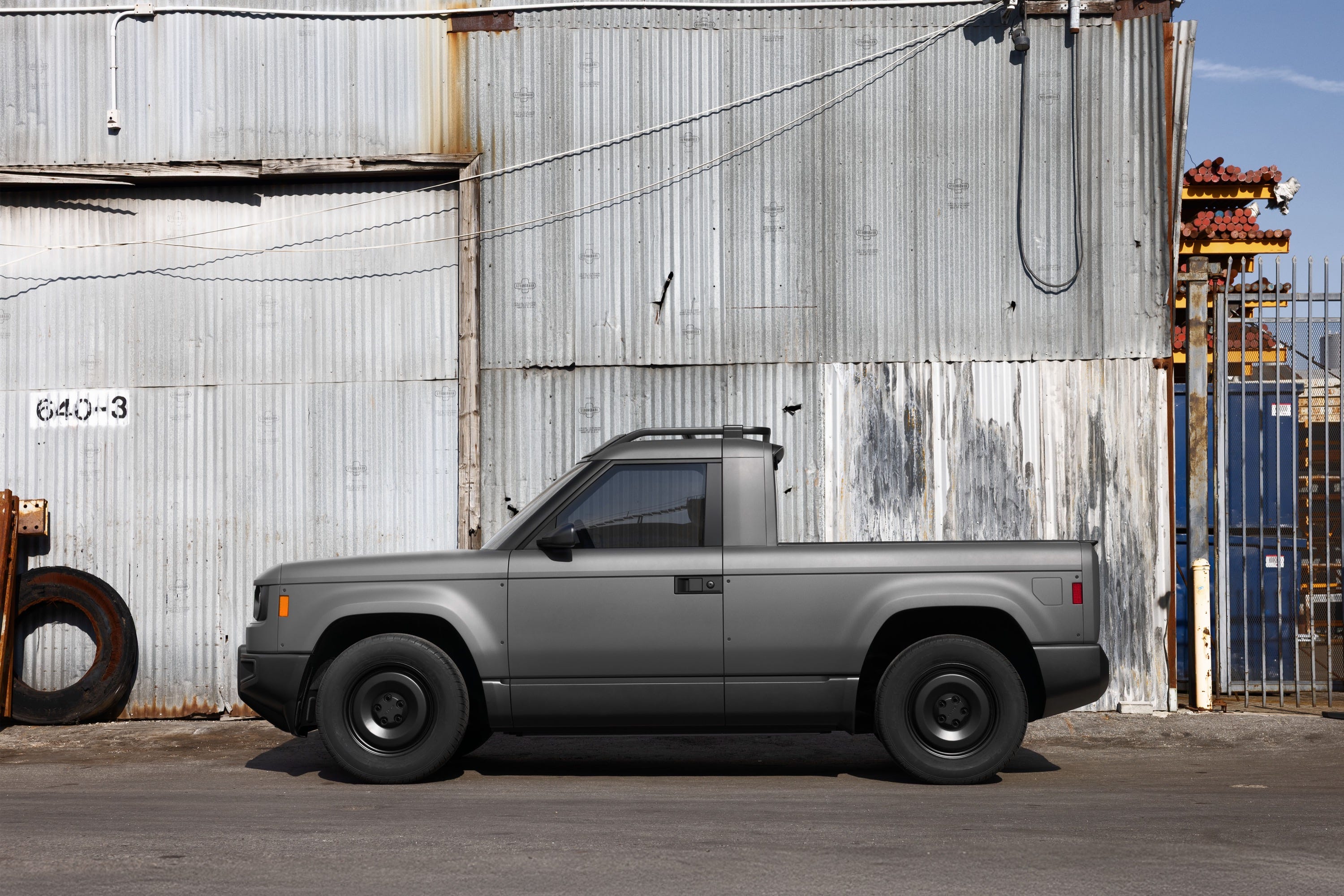
I am not really a car guy. It’s very un-Midwest of me. What’s more, the electric vehicle niche within the expanded car-guy universe is one that I am nonplussed by. You are telling me that you made a car that doesn’t go as far and it’s door handles are confusing. What am I supposed to like about that?
As a Midwesterner, I can’t deny that the Midwestern economic experience is inextricably linked to the automobile. Detroit’s Big Three, the regional tier one, two and three OEM suppliers, and all of the surrounding supporting cast are a big part of many people’s reasons for living in this part of the country. Much of our economic strength is still reliant upon this region’s ability to produce cars at massive scale. Even some of our other industrial segments in the Midwestern owe their success to the auto industry - vehicle manufacturing know-how helped us build other products as well very effectively. The auto manufacturing in this country has historically been linked to this region.
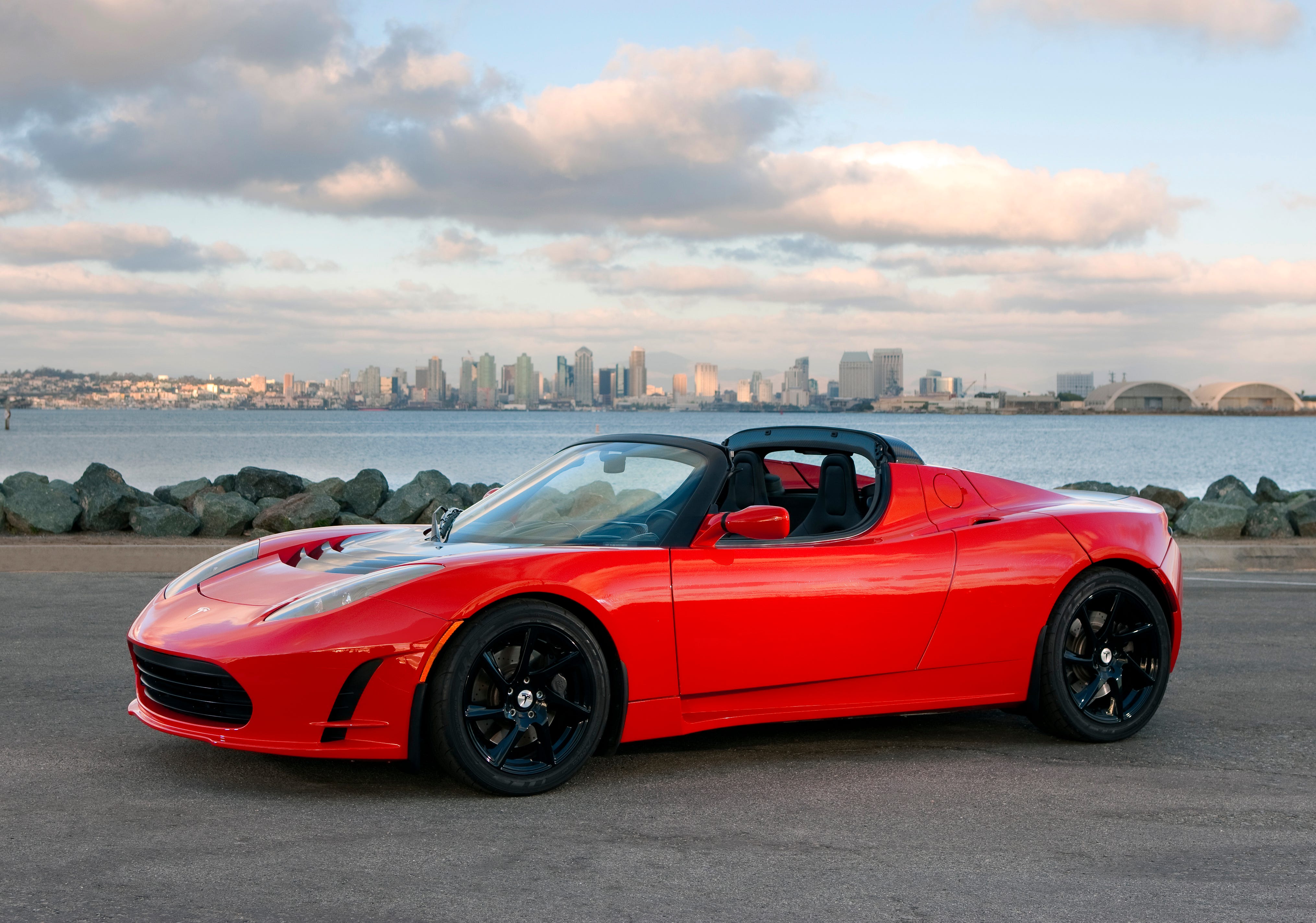
BUT, it is undeniable that one of the greatest business stories in the last 25+ years is Tesla, not based in the Midwest. No one had really, successfully built a car manufacturer in the United States and reached any level of scale in many, many decades prior to them. In fact, the industry largely saw consolidation and, during the Great Recession, took a drubbing. In stark contrast to the seemingly downward spiral of the rest of the industry, Tesla built a new car company from first principles and they made it electric, literally. They figured out a way to mass produce EVs that didn’t look stupid. And they made them electric, metaphorically.e The original roadster is pretty dope looking and many of their vehicles carry on that legacy.
But, of extreme note: they didn’t do this in Michigan. They built this company far outside of the reaches of the Detroit auto industry. This is obvious in hindsight - in order to build a company that flies in the face of the existing industry, it’s best to do it from an outsider’s perspective. This is a regional, rather than company-specific, innovator’s dilemma at work.
Now, you can rag on Tesla, how they look, the man who built the company, the government subsidies for EVs, the Cybertruck, how they look, the dumb car door handles, the fart sound, how they look, and a litany of other things. But most auto manufacturers do similarly stupid things as well. But you can’t deny that they have done it: built the next generation of great automotive manufacturers. TTM Revenue of nearly $100 billion, $13 billion in EBITDA, and delivery of a ton of vehicles. Sure, maybe you think it’s overpriced or whatever - I don’t care. It’s a real company. A real company based in Austin, Texas, not Detroit, Michigan. (Tesla did have some auto experience on the founding team, but not nearly at the level one would expect).
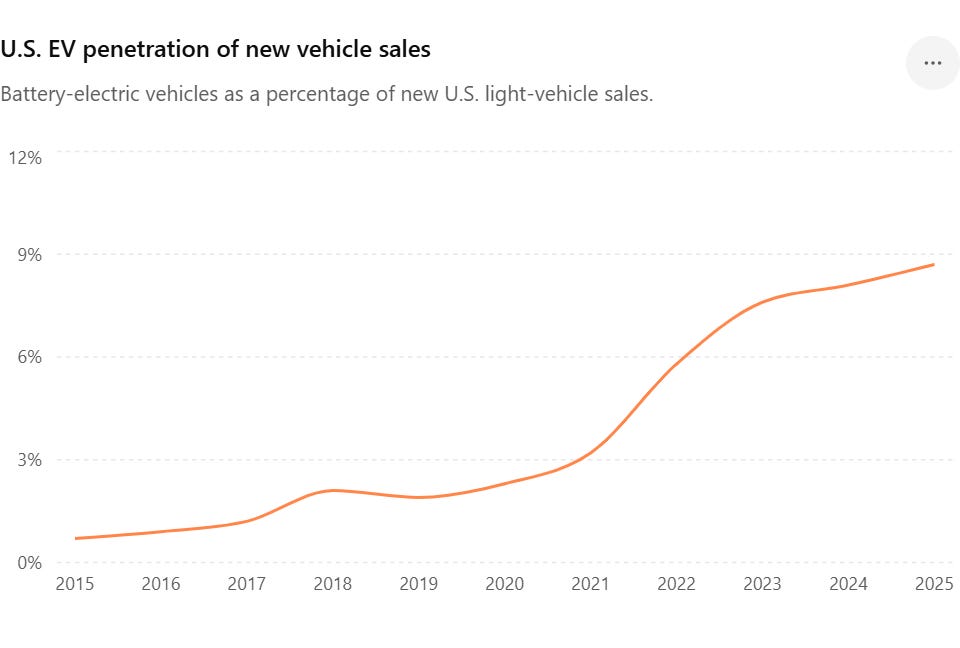
Tesla has been, for a long time, the number one existential threat for Detroit auto manufacturers. Of course, before Tesla, there were Asia and European car imports that threatened Detroit’s stranglehold on the American car-buying public. These failed and succeeded in that task in a lot of different ways, but that story is decades old. And in the future, there is a discussion worth having about Chinese auto-manufacturers, but I am skeptical across several vectors and it’s still pretty theoretical. For the last ten years, the biggest question everyone in Detroit has been asking is how to build a competitive EV and not lose that race.
And Detroit has done an okay job of responding. They have started catching up to Tesla from an EV production perspective. The Ford Mustang Mach-E sold ~50,000 vehicles last year. But the leader in the category is still Tesla. The Tesla Model Y sold ~300,000 vehicles last year. Maybe Detroit got to the EV party a little too late, and the ship might have sailed - I sort of doubt that. This is a long race being run right now. We are still very early innings.
But just because Detroit’s incumbents are on shaky ground regarding EVs, that doesn’t mean that Detroit is SOL. The region still has a ton of auto-know-how that even Tesla sometimes plays catch up on. ICE engines are still the main thing, for now, and Detroit does a pretty good job making those. And when you look at the Cybertruck, Tesla’s most recent big release, it hasn’t really been much of a success. Its unit sales in 2025 (in the second year of its release) declined by ~48%, approximately selling 20,000 units. The Ford F-150, on the other hand, sold 700,000. Evening the Ford Lightning sold more than the Cybertruck. There are lot of reasons for that, but the reality is that Detroit is still pretty dominant in the truck manufacturing space.
In order to survive, the Cybertruck focused on the luxury truck buyer. That’s a real market, but not a huge one, and still pretty competitive. Other trucks are expensive, but they are viewed as investments primarily, then status symbols secondarily (at least, that’s the outward projection - projecting an investment sometimes is a status symbol, but that’s a different blog).
But the Cybertruck isn’t the only EV truck out there not made by a historically significant auto manufacturer. One of the first breakthroughs in this space was Rivian. A company that is based in California, but very early days started hiring automotive talent from the Midwest, particularly in Chicago and Detroit. They continue to hire a ton of folks in Detroit and the city serves practically as it’s second HQ. The Company was mostly focused initially on trucks, then SUVs. They are pretty slick looking and you can barely tell they are EVs. And you almost certainly would recognize their Amazon trucks - that is their commercial business line as well.
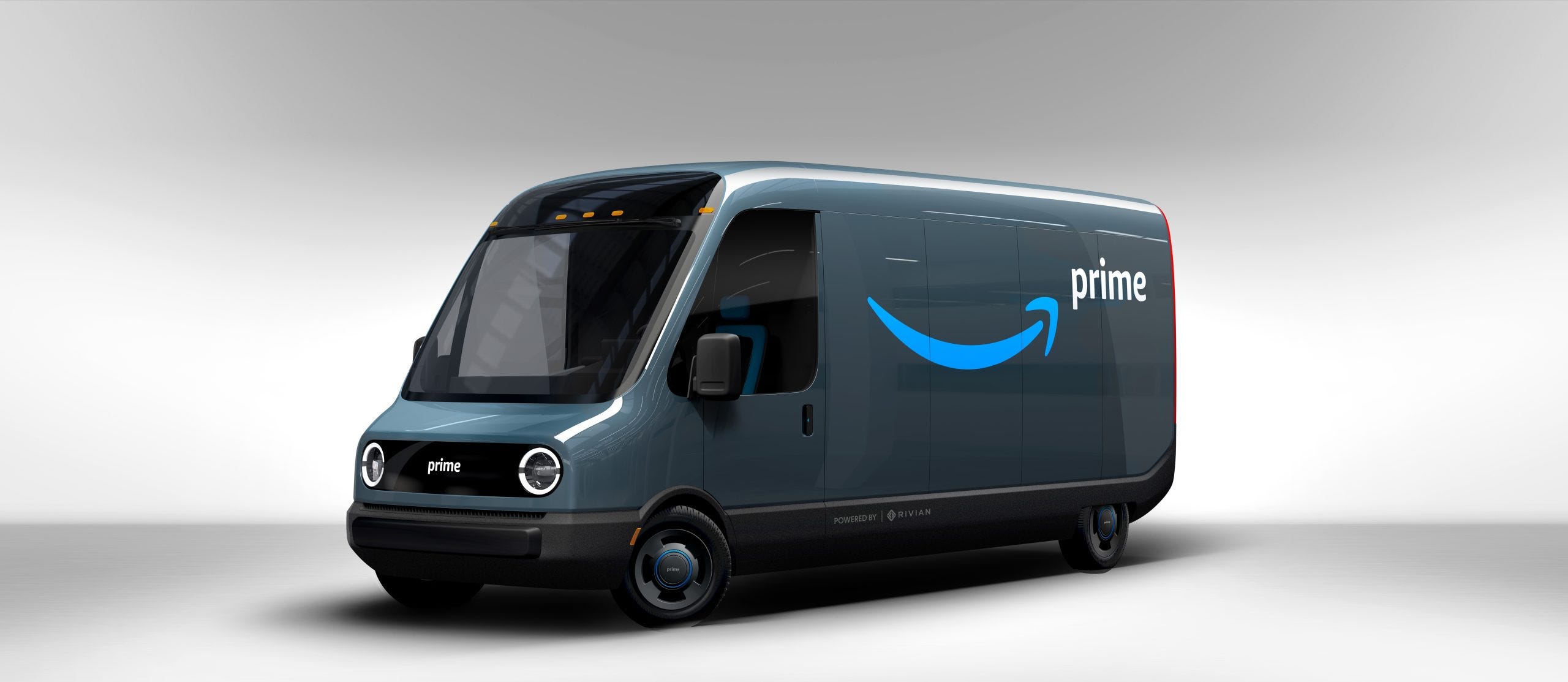
However, They have done well largely not because they are a truck company, but because they are some weird EV-version of a Jeep, plus they have commercial partnerships with groups like Volkswagen and Amazon. They also built their manufacturing facility in Normal, Illinois. It was a retrofitted industrial site that they made best use of to-date.
Amazon represents roughly half of Rivian’s automotive sales to-date. On top of that, their partnership with Volkswagen is focused around software, not vehicles. In 2025, Rivian did $5.39 billion in revenue, of which $3.83 billion came from auto sales and $1.56 billion came from Software and Services Revenue. Most of that software revenue is Volkswagen, up from $484M in 2024. That is also what generates any profit for Rivian, as the auto business still runs at a loss.
So, Rivian is a cool story, and the vehicles are pretty sick (except the Amazon delivery EVs, which are kinda lame). But it’s not an EV truck success story.
But there is another player that has entered the fray: Slate Auto.
Slate Auto recently announced a new factory in Warsaw, Indiana, the home of a ton of orthopedic device manufacturing as well as close to the epicenter of RV manufacturing. Recreation Vehicles, if you are not from Indiana and don’t realize this, are basically all made in Northern Indiana. What about that part of the country makes it so ripe for RVs? It’s hard to say exactly. But of course, if you are building the land-yacht for the common man, the Midwest isn’t such a bad place to do it.
Slate Auto is headquartered in Troy, Michigan. It’s backed by Jeff Bezos, among other deep-pocketed players. It recently raised $650 million in venture capital, bringing it’s total raise to $1.17 billion. They have yet to release a car, but they have been taking pre-orders for quite some time.
The angle here is that this is a car truck for the everyman. It’s retailing for ~$25K and, like the main Detroit man Henry Ford once said: “Any color the customer wants, as long as it’s black.” While that’s not exactly correct, it is a spiritual successor to the Model T. The point is that this is a truck for anybody to drive. It is the EV that is accessible and also doesn’t make you look like a moron. It has real truck bed storage, and it can actually be a work truck.
That last point is one I am not so sure of - will this actually be a truck that you can haul loads in? Will it have broader appeal compared to the Cybertruck or even the F-150 Lightning? That’s hard to say until it is actually out in the market. It is really banking on the idea that it has none of the features you don’t need. But that implies that the features it does have are really strong. And it’s hard to know how true that is going to be.
Early signals on consumer sentiment are good. It has allegedly received 160,000 pre-orders to date. And it’s going to start delivering vehicles in 2026. While those are refundable pre-orders and didn’t require a big down payment, it’s still helpful when assessing broader interest in this market.
There are two things converging here. One is the Midwest’s ability to build a car at massive scale, and the Midwest’s ability to build a car that people actually like. Those are two different skills. Detroit has proven an ability to do both, especially when it comes to trucks. Again, the F-150 dominates that market for a reason. Both because they can make a ton of them and there is a ton of demand. Basically nowhere else has demonstrated an ability to do both. And even Detroit hasn’t been able to do it with EVs yet.
The thing about Slate is that it is an excellent test for the broad reindustrialization narrative that is currently sweeping the country and more specifically the Midwest. They are taking interesting technology (EVs), applying our industrial know-how (employees from GM, Ford, Rivian, etc. are crawling all over the place) and setting it in a brownfield site in Warsaw, Indiana (it was a former phonebook manufacturing facility that closed down in 2023). This is the confluence of everything everyone is talking about when they talk about bringing back the American industrial base. If it can’t work on this thesis, we likely need to go back to the drawing board. Most hardware / equipment tech startup manufacturers deal with an issue around production - can they scale up building product in a capital efficient manner. That is what this region is known for - Detroit was built on that idea. This, in theory, should not be AS BIG of an issue for Slate as anywhere else.
So it is tapping into a couple of Midwest Playbook themes to gain a foothold in the market rarely seen as of late:
Talent Arbitrage: it is HQ’d in Detroit and building product in Warsaw, Indiana. It is banking on the vehicular know-how of the talent base in the region to help them build a truck for the common man. Something the Midwest still clearly does better than anybody else. Just look at some of these leaders at Slate and their backgrounds to prove this point:
Chris Barman - (Former CEO & President of Vehicles) Fiat/Chrysler
Peter Faricy - (CEO) no real auto experience but Michigan State / University of Michigan Alum!!!
Ryan Green - (CFO) former Rivian, Ford, and Harley Davidson
Simon Phillips (Corp Dev) - Rivian and Ford (24 years!)
Eric Keipper (Head of Engineering) -14 years at Fiat Chrysler!!
Industrial Inheritance - Warsaw is known for manufacturing Orthopedic devices. While that’s not necessarily cars, it does mean that they know how to build and manufacture complicated devices at higher price points in an efficient manner.
Geographic Arbitrage - the everyman doesn’t live on the coasts. So don’t build your truck there either. I have a buddy who lives in SF and drives a Tacoma. He doesn’t stick out like a sore thumb, but he’s not exactly Mr. Mainstream. Sure, Texas has a lot of truck owners too, but they say that Austin is weird for a reason. Truck drivers, the people who use this stuff for work, live in the Midwest. Go to a Bengals tailgate and tell me otherwise. Building close to your consumer is almost always a good strategy, especially in this part of the country.
The one variable, as is always the case, is whether or not people will want to buy the product. They have a lot of pre-orders already, which is a great sign, but so did the Cybertruck. And there’s a big difference between hype-cycle pre-orders and actual converted customers. Especially once the consumer sees it driving around in the real world and can make a more informed decision. There are a lot of variables that go into making a car purchase decision like this. But Detroit still knows what sells trucks, so it’s not a crazy leap to make. These are concentric circles of risk.
BUT, if they do pull it off, it’s a huge sign of things to come. Not only can America build a scaled auto manufacturer, but the Midwest can as well.
And if the Midwest can do that, then what else can we do?
Does it come in Bearcat red?
Worth noting: Tesla is an Austin company now, but that's not where they built their success, it's where they moved after achieving success. Tesla is very much a Silicon Valley company even now, just one that happens to be headquartered in Texas.